
When Language Stopped Sounding Human: On Words, Accountability, and Choosing Honesty

Updated: Apr 27
“Too much jabbering at each other. Not enough care about humans.” — Leonard Nimoy, 2014
I don’t exactly know where to begin. This has been sitting with me for a long time. Years, if I’m being honest. I think my issue is language. Not grammar. Not intelligence. Just… the way things are said now. The words. The phrases. The tone. It’s everywhere. Corporate executives. Politicians. Press releases. Statements. Apologies. Everyone seems to be speaking the same way, using the same phrases, as if they all came from the same template. And the longer I sit with it, the more unsettled I feel. Something about it just doesn’t feel human anymore.
One phrase that always comes to mind is “going forward.”

On its own, it’s harmless. It sounds productive. Optimistic, even. “Going forward, we’re going to do better.” “Going forward, we’re implementing changes.” I’ve heard it on the news, in interviews, corporate presentations, and even in places I used to work. I’ve heard it so many times that it’s almost invisible—something I register without really noticing anymore. And yet, every time it surfaces, it still lands the same way. The more I hear it, the more it starts to feel like an eraser. A way to acknowledge that something happened without ever sitting with what that something actually was. It gestures toward improvement while quietly stepping over any accountability. Saying “going forward” feels like saying 'let’s not talk about what just happened'. Like it absolves the speaker simply by pointing to the future. As if intention alone is enough to wipe the slate clean. I’ve heard it after data breaches. After mass layoffs. After airline meltdowns and corporate scandals. After public apologies that never quite sound like apologies. Different industries. Different stakes. Same language.

I heard it after the Equifax data breach in 2017, when personal information for over 140 million Americans was exposed—names, Social Security numbers, birth dates, data people can’t simply replace. For many, it wasn’t just a breach of data; it was a loss of control. People froze their credit. They worried about fraud they couldn’t see coming. They were told to monitor accounts for years, maybe decades, for damage that might surface long after the headlines faded. And in response, the language was familiar. Statements emphasized “taking privacy seriously” and “implementing safeguards going forward.” The future was addressed quickly and confidently. The fear people were left with—open-ended, ongoing, and deeply personal—was harder to find in the words.

I heard it again years later during the Southwest Airlines operational collapse in 2022, when mass cancellations stranded travelers nationwide. Families slept on airport floors. Holidays were missed. People ran out of money, medication, and patience. Employees were left absorbing the anger of customers while navigating systems that couldn’t support them. The response focused on future investments, modernization, and improvements "going forward". Plans were outlined. Commitments were made. But in the moment—when people were cold, exhausted, and unsure how they were getting home—the language felt distant. Technically correct. Carefully constructed. It spoke to systems and solutions, while many customers were still just trying to be seen. These were very different events with very different consequences. But the language used to respond to them is strikingly similar.
“We take this seriously.”
“We’re listening.”
“We’re committed to doing better.”
The details change, but the phrasing doesn’t. And after hearing it enough times, it stops sounding reassuring and starts sounding familiar—carefully constructed, emotionally distant, and oddly interchangeable.
When Words Become Distance

Another word that’s been everywhere lately is “rhetoric.” Especially in politics. It’s a strange word to hear so often because of how clean it sounds. Neutral. Academic. It turns charged, emotional language into something abstract—something that can be discussed at arm’s length, without ever fully acknowledging what it may have caused. I’ve heard it used after elections, after protests, and after acts of political violence—moments when lives were lost, when families were grieving, and when communities were left shaken and searching for meaning. In those moments, leaders often urge calm by calling for the “rhetoric on both sides” to cool down. But when everything is reduced to rhetoric, something important gets lost.
Fear becomes tone. Harm becomes language. Responsibility becomes a matter of phrasing. The focus shifts away from what actually happened and toward how it was talked about, as if the words existed separately from their consequences. For the people living through those moments, that shift can feel distancing. Their experiences are often reorganized into something more presentable, more neutral, more manageable.

In those moments, it feels less like an attempt to heal and more like an attempt to neutralize. When words stop carrying care, people start acting like abstractions. Instead of talking about harm, intent, or responsibility, we talk about rhetoric. As if words exist in a vacuum. As if they don’t shape how people think, act, or treat one another. I’ve noticed a similar flattening happen with the word “narrative.” It’s used everywhere, across politics, media, and corporate messaging. Conversations stop being about what happened and start being about “the narrative around it.” Once something becomes a narrative, it’s no longer treated as a lived experience. It becomes something to manage, shape, or counter. People aren’t responding to harm anymore — they’re responding to how that harm is being framed. And for the people inside those moments, that shift can feel like being edited out of their own story. And once language starts functioning this way, it spreads.

Sometimes it feels like everyone is copying everyone else. Not consciously—but consistently. Like corporate language and political language have merged into one bland dialect that prioritizes sounding professional over sounding sincere. And that’s not because the words themselves are complicated or unfamiliar. It’s not a failure of intelligence, or vocabulary, or education. Big words aren’t the problem. Precision isn’t the problem. The problem is repetition without substance. When the same words are used often enough, you start to wonder why these words were chosen—and what they’re trying not to say.
When Language Collapses Complexity
There’s another kind of language that’s become just as common, but in a different way. Words that don’t soften or sanitize—but compress. Language that takes something complicated, emotional, and specific, and flattens it into something easier to manage.
I’ve heard this kind of compression in responses from game publishers like Electronic Arts and Activision Blizzard during the monetization backlash—moments when players weren’t just upset, but frustrated, exhausted, and feeling ignored. In those cases, the concerns were often specific and deeply felt: games designed around grind instead of fun, systems that nudged players toward spending without clearly saying so, and mechanics that felt less like choice and more like pressure. Players weren’t just reacting to prices; they were reacting to a sense that something they loved was being reshaped without their consent.
The responses, however, tended to sound familiar. Statements emphasized listening to feedback, learning from the community, and evolving approaches going forward. The language acknowledged that players were unhappy, but rarely named what they were unhappy about.
The conflict was smoothed into something vague and manageable—concerns were raised, conversations were happening—without directly engaging the behaviors that caused the backlash in the first place. For players, that gap mattered. It didn’t feel like a conversation. It felt like being talked around. Like the emotional reality of disappointment, distrust, or burnout had been compressed into a handful of neutral phrases that could apply to almost any situation. This isn’t unique to corporate statements, though. The same compression shows up just as often in everyday language. Words like “Toxic.” “Woke.” “Unwavering.”
When Words Replace Understanding

“Toxic” used to mean something severe. Harmful. Abusive. Dangerous to remain around. It described environments or behaviors that actively caused damage—things you needed distance from in order to stay safe. Now it gets applied to people, relationships, workplaces, opinions—sometimes without explanation. Once something is labeled toxic, the conversation is effectively over. There’s no nuance. No context. No curiosity about how things reached that point or whether change is possible. It’s a powerful word because it removes the obligation to explain. Labeling something toxic can feel decisive, even protective. It draws a clean boundary. But it can also flatten complicated situations into something final and unquestionable. I’ve seen this happen in workplaces, online discourse, political debates, and even gaming communities. A concern becomes a verdict. A disagreement becomes a diagnosis. Once the word is applied, discussion stops. The label replaces the explanation.
And for the people on the receiving end of that label, the effect can linger. They don’t just feel disagreed with—they feel written off. Reduced to the worst version of a moment, rather than understood as someone capable of growth, accountability, or change.
“Woke,” however, is probably the most divisive word here. It didn’t start as an insult. It meant awareness. Paying attention. Staying awake to injustice. Even the word itself points to that—woke as a play on awake. Stay aware. Don’t ignore what’s happening around you. Don’t turn away. It emerged from within the African American community as a way of naming lived experiences—calling attention to systemic injustice, violence, and inequality that many people were able to ignore because it didn’t affect them directly.

It wasn’t about superiority or performance. It was about survival. Over time, though, the word stopped being a description and started becoming a judgment. It was pulled out of its original context, stripped of its meaning, and turned into something else entirely. What began as a call for awareness was reframed as an accusation. Used often enough, and by enough different people, it became a shortcut—a way to dismiss without engaging. Now it’s so overused that it barely means anything at all. Depending on who’s saying it, “woke” can mean compassionate, condescending, dangerous, performative, or ridiculous. It can signal moral seriousness—or invite immediate rejection. What makes the word especially harmful is how easily it’s weaponized. Once a person, idea, or institution is labeled “woke,” the work of explanation is over. The word does all the talking. Context collapses. Intent disappears. Nuance is flattened into a single signal. And for the people whose experiences the word once tried to name, that loss matters. When a word meant to describe harm is turned into a punchline or a threat, something human gets erased along with it. The conversation doesn’t just end—it never really begins.
I’m aware that even the word “weaponized” has started to fall into this same pattern. It’s everywhere now. Ideas are weaponized. Language is weaponized. Silence is weaponized. And here I am, using that word myself sometimes, without even realizing it. It slips into sentences easily, especially when trying to describe something that feels sharp or hostile or intentionally harmful. Sometimes that description is accurate. Words can be used deliberately to harm, to provoke, or to shut people down. But like “toxic,” the word has become so common that it often replaces explanation instead of supporting it. Saying something has been weaponized can feel like saying this was done with intent, without having to explain how, why, or to what end. The word signals danger immediately—and once it’s used, the conversation often narrows instead of deepening. Questions turn into assumptions. Curiosity gives way to defensiveness. What could have been an exchange becomes a sorting process: who’s safe, who isn’t, who can be dismissed without further thought.
When Language Assigns Motive

As I’ve been reading more about these moments, I keep running into another word that shows up just as often: “embolden.” It’s usually used to suggest that language didn’t just exist, but pushed people toward action. Sometimes that may be true. Words can influence behavior. But “embolden” is another word that does a lot of work very quickly. It implies cause without having to explain the steps in between. It suggests motivation without naming the fear, anger, isolation, or grievance that made someone susceptible in the first place. And in doing so, it rarely asks why that emboldenment occurred — or who paid the emotional cost along the way. When we rely on that framing too heavily, people start to fade from view. Human complexity gets replaced by implication. And that’s how these words gain momentum. They move quickly, picked up and repeated until they feel inevitable. What’s striking is how easily that momentum turns into posture. Once language starts sorting people into sides—once intent is implied instead of understood—flexibility itself begins to look like weakness. What was once described as influence becomes framed as resolve.
And that’s where words like “unwavering” enter the conversation.
“Unwavering” sounds admirable. Strong. Resolute. It belongs to a broader language of certainty—one that signals resolve without hesitation and leaves little visible room for doubt. It shows up constantly in official statements and headlines, often presented as a marker of moral clarity. But it’s also frequently used as a substitute for reflection. To be unwavering is to refuse to move—but sometimes movement is growth. Sometimes it’s learning. Sometimes it’s admitting you were wrong. When unwavering becomes a virtue on its own, it quietly discourages humility.

What all these words share is efficiency. They’re fast. They’re emotionally loaded. And they save the speaker from having to explain themselves. Instead of describing behavior, we label it. Instead of unpacking ideas, we dismiss them. Instead of talking to each other, we throw words like switches—on or off, good or bad, acceptable or unacceptable. Now, I’ll be the first to say that I’m not an expert. I’m not a linguist. I don’t study language in an academic sense. What I have done is listen. For years. I’ve sat in meetings, watched press conferences, read statements, listened to apologies, absorbed interviews, scrolled headlines, and heard the same phrases repeated across different industries and different crises. I’ve watched how language changes when accountability gets uncomfortable—and how certain words start to appear precisely when clarity disappears. I’m just an average American trying to make sense of what I’m being told.
But when you hear the same language long enough, in enough different places, patterns start to emerge. And once you see those patterns, it becomes hard to unsee them. And to me, words matter. How they’re said matters. Who they’re said to matters. When language starts to feel overly polished, overly careful, it stops feeling like communication and starts feeling like performance. Like people are hiding behind words the way you’d hide behind a shield. I keep thinking about a scene from The 40-Year-Old Virgin, where Kevin Hart says, “You’re throwing too many big words at me. And because I don’t understand them, I’m going to take them as disrespect.” It’s a joke, but it lands because there’s truth in it.
When language feels deliberately inflated, it doesn’t just confuse—it alienates. It creates distance. And distance is the opposite of communication. All of this leaves me wondering when simply speaking plainly started to feel so rare—and why doing so now feels almost radical.
Why Plain Language Now Feels Radical
What I find most striking is that none of this is new. This kind of language—this 'rhetoric that shapes narratives' for better and worse—has been analyzed, debated, and written about for decades. What’s new, at least to me, is realizing how long it’s been happening, and how many people have noticed it before I ever had words for it. As I’ve been digging into this, reading, listening, and paying closer attention, I’ve realized I’m not alone in feeling this way.

The repetition. The patterns. The templates. Once you start noticing them, they’re hard to ignore. And the thing that stands out most is how rarely anyone speaks plainly. I don’t hear people talking the way I do—or the way most people I know do. I hear carefully constructed language designed to sound authoritative or intelligent, but stripped of emotional weight. It’s precise, but distant. Polished, but hollow. Once you see the pattern, it’s hard not to notice how little room there is for genuine connection. That realization is what pushed me to ask why—why plain speech feels so absent now. Why speaking plainly often sounds out of place. Why clarity, of all things, seems to carry risk.

And in a lot of ways, I can see how we got here. In the corporate world, professionalism matters. Precision matters. Saying the wrong thing can carry legal, financial, or regulatory consequences. I get that. But professionalism and respect are not the same thing. And somewhere along the line, they started being treated as interchangeable. That’s the moment where plain language didn’t just become uncommon—it started to feel risky. What gets lost in that exchange is the audience. Language can be professional without being human. It can be technically correct while still feeling evasive. When speech is engineered primarily to protect the speaker or the institution, clarity becomes secondary. And when clarity disappears, so does trust.

For example, there’s another phrase that started standing out to me during the early days of the pandemic: “in real time.” I heard it repeatedly in press conferences, often in response to questions people were asking because they were scared, confused, or trying to plan their lives. “We’re looking at that in real time.” On paper, it sounds responsible. Careful. Adaptive. But after hearing it enough, it began to feel hollow. Like a way of acknowledging uncertainty without offering reassurance or direction. Everything was always being evaluated, always unfolding, always in motion—but rarely explained. For people living through that uncertainty, trying to make decisions about work, school, health, and family, “in real time” didn’t feel responsive. It felt indefinite. Present tense without presence. Action without clarity.

I sometimes wonder how much of this comes from regulation. In the United States, what gets broadcast comes with rules, standards, and guardrails. Organizations like the Federal Communications Commission exist for a reason, and I’m not arguing against their existence. But when language is shaped too heavily by fear—legal, political, reputational—it starts to sound less like communication and more like condensation. Everything important gets filtered out, leaving behind something vague, cold, and hard to hold onto. In politics especially, language feels distilled down to the safest possible form. Words are chosen not to explain, but to survive. Statements are crafted to offend no one and commit to nothing.
The result isn’t unity—it’s emptiness. Everyone hears the words, but no one feels spoken to. Plain language is direct. It names things. It creates records. And once something is clearly stated, it can’t be easily walked back. Saying “we failed” is riskier than saying “mistakes were made.” Saying “we hurt people” is riskier than saying “concerns were raised.” Plain language creates accountability, and accountability creates consequences.

I’ve heard phrases like “unintended consequences” and “in hindsight” used to describe harm that unfolded slowly, over years. During the opioid crisis, companies like Purdue Pharma relied on this language to acknowledge that something went wrong while framing it as something only fully understood after the fact — not something that might have been questioned earlier, or stopped once the damage became visible. But for the people living inside that harm, there was nothing abstract about it.
Families watched loved ones change, disappear, or die. Communities absorbed waves of addiction, grief, and loss that didn’t arrive all at once, but accumulated quietly, relentlessly. By the time the language caught up, the damage had already settled into daily life. In that context, words like “unintended” don’t feel neutral. They feel distancing. They suggest inevitability instead of responsibility, as if no one could have known — even as warning signs mounted and harm was unfolding in plain sight. The words sound careful. They sound professional. They also sound final. Like a way of closing the book on something that many people are still living with. Careful language, used this way, doesn’t clarify the past—it seals it off.
Maybe that’s why plain language feels radical now. Not because it’s aggressive or crude, but because it’s honest. Because it treats the audience as capable of understanding complexity without needing it to be wrapped in layers of insulation. And yet, instead of meeting that honesty with engagement, the response I see most often is withdrawal.
Refusing the Shrug

There’s a response I see everywhere now, especially in the online world, whenever real discussion starts to surface. Between social media posts, Reddit forums, and endless comment sections across YouTube, it arrives quickly—almost reflexively—as if it’s meant to shut the door before anything uncomfortable can settle in.
It rarely argues back. It doesn’t engage. It just shrugs.
Or the most common one of all, and in my opinion, the worst one of all, one that is delivered with tired sarcasm:
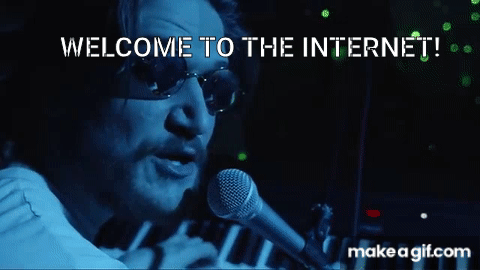
It sounds knowing. It sounds realistic. But what it really says is: 'this is how it is, and there’s no point expecting anything better'. That response doesn’t challenge empty language — it completes the cycle. After hearing hollow statements long enough, people stop engaging. They stop expecting clarity. Cynicism becomes a form of self-defense. I understand where that comes from. But I don’t want to live there.

I’ve seen what happens when people speak plainly instead. When they speak honestly. When someone says, without insulation or spin, “We were wrong,” or “This hurt people,” or “Here’s what we’re going to do, and here’s why.” Those moments don’t fix everything. They don’t erase harm or end disagreement. But they change the temperature of the room—not because anyone was told to calm down, but because something real was finally said. They invite trust instead of suspicion. They make people feel spoken to instead of managed. When words carry care, people feel human again. That, to me, is what it means to be human in how we communicate. Not perfect. Not fearless. Just willing to be clear. Willing to mean what we say, and say what we mean, even when it’s uncomfortable.
I’m not writing this because I think I can fix any of this. I’m writing it because I refuse to shrug and move on as if none of it matters. Over the years, I’ve found myself listening closely to the language around me — breaking it down, noticing the patterns, watching the same phrases repeat until they lose their weight — and their meaning. And somewhere along the way, I realized something simple but important: my voice matters. My words matter. How I speak matters. Not because I have all the answers. But because I’m trying to speak with empathy, compassion, honesty, respect — and yes, love — in a world that often rewards distance instead.

I try to look at all sides. I try to understand why people speak the way they do, even when it frustrates me. But I also know that understanding isn’t the same as excusing. This essay is a form of calling it out. Not by naming villains or assigning blame, but by holding the language itself up to the light and asking what it’s doing — and what it’s failing to do. When the same phrases appear after harm, after fear, after loss, that repetition matters. Patterns matter.
I’m not interested in pointing fingers at individuals as much as I am refusing to let the language go unexamined. Because when words stop sounding human, when empathy gets edited out in favor of safety or polish, that absence deserves to be named. And at the very least, I want to be honest about my own role in that. To slow down. To choose my words carefully. To say what I actually mean — even when it would be easier not to.
In a world full of rehearsed language and resigned responses, that feels like the smallest form of resistance I can offer. Not perfection. Not purity. Just honesty. Just speaking like a human, to other humans — and believing that still matters.
Thanks for reading.
Sincerely,
Nathaniel Hope


Damn solid piece my friend. Words do tend to evolve as time goes on and not all for the better. Another word that is being used for a lot of things but more meaning the same thing in general is "Fatigue" but it's being lumped in with a word in front of it now. _____ fatigue. "Insert word here" fatigue. In essence I feel people like to hide behind certain words to hide accountability. Its unfortunate people cant just be honest and straight forward about things rather than using convoluted language to make people second guess what's actually being said.