
The Illusion of Progress

Flying Into the Future on 40-Year-Old Wings—and Still Waiting to Take Off

I went flying recently. Guess what? Flying hasn’t changed much, at least not where it counts. Sure, we now have mobile boarding passes, airport lounges with cappuccino machines, and full-body scanners that make you look like a blurry action figure—but the flying experience itself? It still feels like the same cramped, uncomfortable ordeal I remember all the way back when I was a kid.
Before I was even born, there was a sense of awe around air travel. It was exciting—almost glamorous. You’d dress up to fly. The flight attendants wore tailored uniforms and smiled like they were trained at Disney. Airlines like Pan Am and TWA had an identity, a presence. Meals were hot, trays were metal, and legroom was measured in feet, not inches.

And then, sometime between deregulation and the bottom line, the glamor faded. Planes got smaller, seats got tighter, and that sense of wonder got traded in for efficiency and revenue per square inch. Fast forward to today, and it often feels like we’re flying inside an old relic that’s been polished just enough to pass inspection.
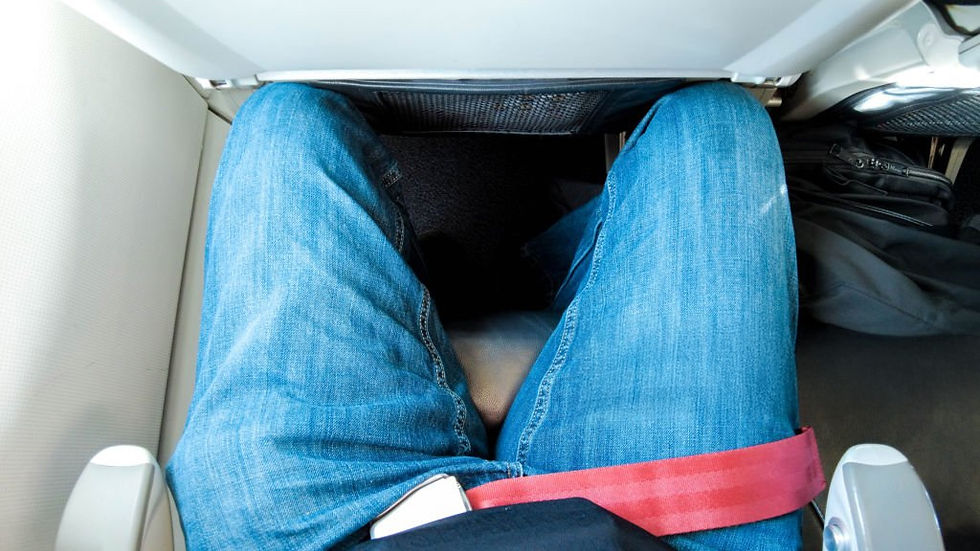
The bones are the same, just with newer seat fabric. Want to check a bag? That’s extra. Want to bring your bag on board? Better sprint through the gate and pray there’s still space in the overhead bin. Otherwise, they’ll “courteously” gate-check it, which is airline-speak for: "Your bag will be handled like it owes us money and might arrive on your next flight."
The seats? Still painfully close. Elbow-to-elbow combat is the standard. Reclining is an act of war. I once made the mistake of trying to cross my legs. I wasn’t successful. Probably better that way because I’m pretty sure if I kept trying I’d nearly dislocate a hip. Airplane windows? They’re still those same tiny oval portholes—nostalgic in shape, but barely big enough to catch a glimpse of the clouds you’re paying hundreds of dollars to sit above.
But the strangest thing is that despite all our technological advancements—smartphones, AI, cars that drive themselves—the airplane cabin feels stuck in time. We’re streaming high-definition movies on Wi-Fi from 35,000 feet above the Earth… while sitting in a seat that hasn’t been rethought since Cheers was still airing new episodes. It’s as if someone hit pause on innovation right around 1989 and decided, “Yeah, that’s good enough."

And maybe someone did hit pause—because since then, the industry hasn’t just stalled, it’s shrunk. The number of major U.S. airlines has steadily declined due to bankruptcies, mergers, and consolidations. Pan Am? Gone. TWA? Gone. Continental, America West, US Airways—folded into larger carriers. We went from a vibrant, competitive field—each airline offering its own vision of hospitality—to a handful of giants, where the differences are mostly cosmetic. The seats may have different logos stitched into the headrest, but the experience is eerily uniform: tight quarters, nickel-and-dime service, and a lingering sense that you’re not really a guest—you’re cargo. Innovation didn’t just slow down—it got absorbed, streamlined, and rebranded out of existence.
And the irony? Airports have evolved dramatically. Some look like upscale shopping malls now—with gourmet eateries, sensory pods, spa lounges, biometric scanners, and enough digital signage to make Times Square blush. Even grabbing a coffee can feel like a boutique experience, with handcrafted lattes served under Edison bulbs. Charging your phone? There’s a sleek, mood-lit station for that. Need a nap? There’s a $40-an-hour sleep pod tucked between designer luggage shops and sushi bars. Everything is polished, curated, Instagrammable—until you actually have to board the plane.

While the terminals keep getting sleeker, the flying experience itself hasn’t kept the same pace. The lounges may be modern, but once you board the plane, it’s still the same cramped seat, the same overstuffed bin, the same nickel-and-dime routine. It’s as if we poured all our progress into the lobby and left the journey itself stuck in coach.

To be fair, not all airlines are created equal. What I’m describing here are carriers based in the United States, where I live and have flown extensively. Over the past 40 years, I’ve traveled with just about every major U.S. airline, to destinations all across the country. And it’s when you step outside that domestic bubble—when you look at how international carriers operate—that the harder questions start to form. The contrast is striking. Painfully so. Japan Airlines (JAL) gives economy passengers spacious seating, beautifully plated meals, and even the option to reserve a seat away from infants. Singapore Airlines delivers world-class service with real cutlery, generous legroom, and crews trained for nearly five months before ever stepping into the cabin. Emirates transforms flying into an event—hot towels, full meals, entertainment screens bigger than some tablets, and a star-lit ceiling in business class. Qatar Airways provides its renowned Qsuite, essentially a mini private room in the sky, even in business class. ANA (All Nippon Airways) boasts spotless cabins and seasonal Japanese cuisine, even in economy. Korean Air serves up bibimbap, a popular Korean dish, while it treats you like a guest, not just a seat number. These airlines don’t just remind you what flying could feel like—they make you question how we ever let it become anything less. They serve meals with real silverware, offer legroom without extra fees, and treat passengers like people, not problems to be processed. It’s not luxury for the sake of flash—it’s dignity, thoughtfully designed into every detail. You step off the plane feeling like you’ve been taken care of.
Then you fly back to the U.S., and it’s like hitting turbulence in reverse. Suddenly, you’re in a metal tube that feels more like a punishment than a privilege. The contrast is staggering. Flying domestically often feels like a grand experiment in behavioral endurance: How little space, service, or humanity can we offer before people break? It’s not just that American airlines are lagging behind—it’s that they’ve stopped pretending to care. And maybe that’s what stings the most. Not just the discomfort, but what we gave up along the way. I say all this not just to vent—though I’d be lying if I said I wasn’t frustrated—but because I genuinely miss when flying held a sense of adventure, of wonder. Not just a means to an end, but a chapter in the story itself. I remember being a kid, pressing my forehead against the cold airplane window, eyes wide as the clouds drifted past like floating continents.

It wasn’t just a view—it was a glimpse into something bigger, something magical. The hum of the engines, the flickering seatbelt sign, the way sunlight pierced through the cabin at 30,000 feet—it all felt like the future. And then there was the cockpit. I still remember peeking in when the door was open, watching the pilot—cap on, buttons glowing, hands steady at the controls. To me, he may as well have been an astronaut. That moment stayed with me. Because back then, flying wasn’t just transportation—it was transformation. It stirred something inside me. A sense of wonder. A feeling that the world was huge, full of places to go and stories to find. That version of air travel made me dream bigger. It made me believe in the future. And somewhere along the way, we lost that. But I still remember what it felt like. I see it in old memories. Like the time I stared out the window as we descended through a sea of clouds, convinced we were flying through another world. Or the quiet thrill of hearing the landing gear drop and feeling the soft thud beneath my feet—like a secret handshake between the Earth and the sky. I look at this photo—just a kid, eyes full of wonder—and I remember what it felt like to believe the sky wasn’t the limit, just the beginning. I was viewing a world full of possibilities. That’s what it felt like back then. And that’s what I want to feel again.
I think about my daughter and the world she’s growing up in. For her, flying might just mean standing in long security lines, watching her parents juggle luggage and stress, and sitting in a seat that feels more like a punishment than progress. She’ll associate air travel not with awe or excitement, but with bag fees, gate changes, and praying there’s a working USB port to keep a tablet charged long enough to survive the flight. And that’s what gets me: she won’t know what she’s missing. Because the magic’s been quietly stripped away, replaced by the minimum viable product for mass transit in the sky.

It’s hard to reconcile with the past when you realize this wasn’t always our reality. Back when the government regulated where airlines flew and what they charged, service actually mattered. That all changed in 1978 when the Airline Deregulation Act opened the skies to competition—and at first, it felt like a triumph. For consumers, it meant lower ticket prices, more routes, and new carriers entering the market. Suddenly, flying was no longer just for the elite. It was accessible. Democratic, even. Families could afford vacations. Students could visit home without breaking the bank. It was a win—or at least, it seemed like one. But what began as liberation eventually became a race to the bottom. When government oversight fell away, airlines no longer had to compete on quality. They didn’t have to offer hot meals, or comfortable seats, or any real sense of hospitality. They just had to undercut the other guy. Service wasn’t the differentiator—price was. And so, one by one, the little luxuries of flight started disappearing. Legroom shrank. Meals vanished. Customer service became a call center maze. And planes, once designed for comfort and elegance, were retrofitted to squeeze in more seats—more profit—at the expense of everything else.
But the playing field was never truly level. Many of the new carriers that emerged couldn’t survive the turbulence. They folded, merged, or were quietly absorbed by bigger airlines. And in the end, what we were left with wasn’t a bustling marketplace—it was a narrowed runway of corporate giants, each offering a similar, stripped-down experience with a different logo on the napkin. Choice became branding. Innovation became consolidation. And somewhere along the line, we traded vision for volume. What deregulation gave us in affordability, it quietly took from us in imagination. It replaced the romance of flying with spreadsheets. Service became optional. Space became a luxury. Meaning was priced out of the experience.
And yet, we kept flying.
Technology was supposed to carry us forward—make life smoother, smarter, more connected. And in many ways, it has. But when it comes to flying, it feels like we’ve mistaken efficiency for progress. We’ve gotten better at accepting less. We’ve learned to endure smaller seats, longer delays, and fewer answers—not because we believe this is the best we can do, but because we’ve been told this is just the way things are now. All wrapped in sleeker apps, rebranded logos, and glossy promises of convenience.

Somewhere between deregulation and digital check-in, we stopped asking what flying could be—and started settling for whatever got us off the ground. We got better at tolerating less. At shrinking our expectations to fit the seat pitch. At calling it convenience when it was just compliance. As a kid, I looked out the airplane window and saw possibility. Now, too often, we look out that same window and see resignation. And yet… when I see what we once built—and what other countries continue to build—I’m reminded: We’re not stuck because we ran out of ideas. We’re stuck because we stopped believing we could do better. I wish I could say I was writing this from 30,000 feet, drink in hand, stretched out in a reclining seat, basking in the glory of modern air travel. But no—I'm writing this after one of the most exhausting, absurd, and weirdly enlightening travel experiences I’ve had in years. Because while it’s easy to wax nostalgic about what flying used to be—or dream about what it could be—the reality check often hits somewhere between your seventh gate change and your third delayed flight. Turns out, nothing drives a point home quite like living through the exact chaos you’ve been writing about. So buckle up. The next part isn’t theory—it’s turbulence.
A Rough Ride There and Back

I recently flew from Sacramento International Airport to Dallas-Fort Worth for my sister’s wedding. She lives in Texas, and my wife and I were excited to make the trip. We booked the earliest flight out—figuring the more time we could spend with family, the better. But after getting through security and arriving at our gate, we found out our flight had been cancelled. Supposedly due to weather in the Dallas area. Frustrating, but understandable. Still, it was curious that they canceled it outright rather than simply delay it. Even more curious? Another flight to Dallas was still scheduled to depart later that afternoon. That set off a scramble.

Nearly everyone from our cancelled flight rushed to rebook on the remaining one, crowding the gate and clogging up the airline’s customer service lines. Fortunately, my wife and I were able to rebook through the app. Many others weren’t so lucky. Once the chaos settled, reality kicked in: we were now stuck in the Sacramento airport, and it was going to be a long wait. We were originally supposed to arrive at our hotel in Texas at around 6 p.m. Instead, after another delay and a long, cramped evening flight, we didn’t get to our hotel until after 1 a.m. It was brutal. But there was no way I was going to miss my sister’s wedding. And thankfully—we didn’t. That made everything worth it.
The wedding was beautiful. It was great seeing family. And—minor highlight—Texas has Waffle Houses. We went twice during our short visit. Partly because California doesn’t have them, and partly because there’s something about late-night waffles and hashbrowns that sticks with you in the best way. But the return trip home? That’s where things really went off the rails.

Our flight home was scheduled for 11 a.m., so we did everything right—returned the rental car early, got to the airport early, made it to the gate with time to spare. We were tired, sure, but hopeful. Ready to be home. And then… everything fell apart. The flight was delayed—not once, not twice, but three separate times, some switching to a different plane altogether. And the gate? Changed seven times. I don’t mean “moved a few gates down.” I mean we were bounced across every terminal in the airport like luggage with no destination. Seven times. I can't stress that enough. Every time we reached a new gate, the screens would blink, the app would buzz, and we’d be told—without explanation—to start walking again. We spent over ten hours trapped in that terminal carousel, wandering from one gate to the next, dragging ourselves and our bags along with a growing crowd of equally confused passengers. It felt like being trapped in some bizarre airline-themed video game. Every time we got close to a gate, the goalposts moved. No announcements. No apologies. No answers. Just silence, shifting gates, and a creeping sense that we might never actually leave Dallas.

Eventually—mercifully—a plane was ready. But by the time they started boarding, I was exhausted, and of course, the chaos wasn’t done yet. My wife’s carry-on—perfectly fine on the way into Texas—was suddenly deemed too large for the overhead bin. We were told it had to be checked at the gate, taken from us right then and there. And it wasn’t just us. There were others too, caught in the same last-minute scramble. While we waited in line, the attendant on the PA system kept repeating, “It’s a full flight,” as if that explained everything. As if that somehow justified yet another inconvenience, as if we hadn’t already endured enough. I didn’t argue. I didn’t have it in me. I just wanted to get home. And eventually, we did. But that plane ride? Just as cramped, just as full, just as miserable as the one before it.

Still, I couldn’t help but laugh to myself as I watched everyone shuffle down the aisle and stuff their bags into the overhead bins. And wouldn’t you know it? There was plenty of room. Right across from me—an empty bin, wide open. My wife’s bag would’ve fit with ease. After all that fuss, after the drama and gate-checking chaos, that little patch of unused space felt like the punchline to a really bad joke. Like the universe was mocking us. After everything—the cancellations, the gate changes, the waiting—that empty bin said it all. Not just a missed opportunity for convenience, but a symbol of a system that no longer bothers to double-check whether the discomfort it causes is even necessary. Just one more final beat in a story no one cared we were living.

What struck me most was how normal it all felt. That’s what hit the hardest. No one was surprised. No one even seemed outraged. Because this is just what flying has become—a slow erosion of dignity, disguised as standard procedure. The airline never once offered a voucher, an apology, or even a clear explanation. It all just sort of… happened. Like we’re expected to absorb the inconvenience and smile through it. And the way the whole ordeal was handled—or more accurately, ignored—made everything worse. We weren’t just delayed—we were forgotten. And I couldn’t stop thinking: how did we, as a culture—as a society—let this become acceptable? The phrase "customer service" was laughably absent. There was no one around to explain what was going on. No announcements beyond the standard script. The most information I got was from the app, which should not be more competent than the actual airline staff. At one point, I remember thinking: why does the flight tracker on my phone seem more aware of our situation than anyone working the terminal? And then there’s the overhead storage issue. The irony of gate-checking a perfectly fine bag, only to find tons of empty space, was almost comedic. Almost. The whole thing made me wonder how many of these policies are actually based on logistics—and how many are just guesswork and bluff.

More than anything, the experience showed me just how low our expectations have fallen. We’ve gone from demanding dignity and efficiency to crossing our fingers that our plane takes off at all. You don’t feel like a customer—you feel like a number on a spreadsheet. A variable in a profit equation. And heaven forbid you ask for something as outrageous as basic information or human decency. By the time I finally collapsed into that cramped, unforgiving seat, all I could think was how normal this insanity has become—and how deeply not-normal that is. The chaos, the indifference, the silence. It followed me home. It stayed with me. Because none of it felt like a fluke. It felt like a symptom. Of something bigger. Of a system that’s broken—not by accident, but by design.

Later that evening, when the adrenaline had drained and the noise of the day finally gave way to silence, I sat there, staring at nothing in particular, the hum of exhaustion still in my bones. I turned to my wife and said quietly, “Doesn’t it feel like… we’re just stuck? Like we’ve stopped moving forward?” That question didn’t leave me. It echoed long after the plane landed, long after we were home. It clung to me—not just as a comment on the flight, but as something deeper. Something bigger. Because the more I thought about it, the more I realized it wasn’t just about airlines at all. It was about the systems we’re told to trust. The promises we were raised to believe. The future we were supposed to be building.
We’re still crawling through airports, stuck in traffic, waiting on trains that never came. Still navigating outdated systems while the rest of the world moves forward. And maybe the most unsettling part is how unsurprising it all feels now. Like we’ve quietly adapted to the dysfunction. Not with outrage—but with shrugs. The real sting isn’t just the inconvenience. It’s the quiet surrender. The way we’ve let wonder slip from our grip, like it was something childish. Something we were supposed to outgrow.
The Future That Never Arrived
While flying in the U.S. feels like stepping into a time capsule—sealed somewhere between the late 20th century and a PowerPoint presentation promising innovation, it’s not just the skies that are stuck. It’s our trains, our buses, our roads, and frankly, our mindset. Somewhere along the way, the spirit of building forward gave way to maintaining what we already have, duct-taped together and dressed up in buzzwords.
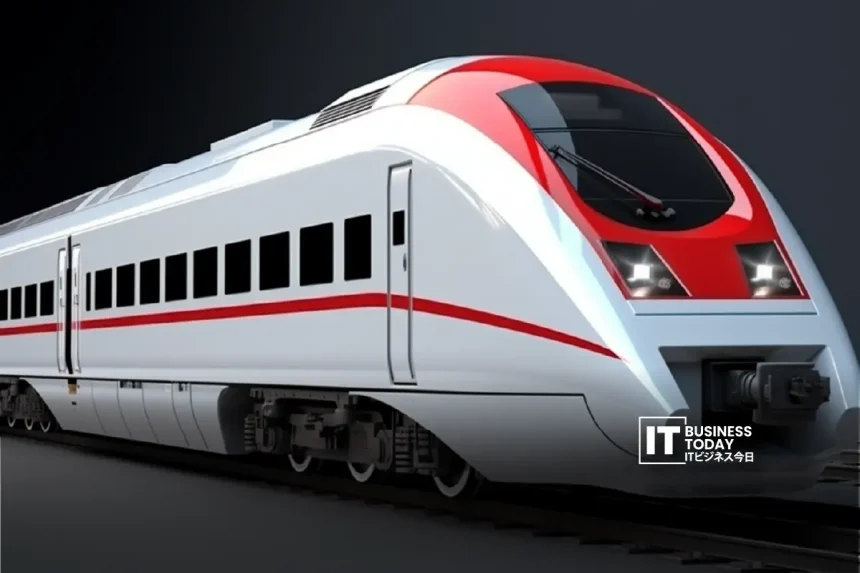
The rest of the world? They didn’t just move forward—they disappeared into the horizon without so much as a sound, while we kept asking if the tracks were safe. Japan has been operating high-speed bullet trains since the Beatles were still together. And they’re not just coasting on that achievement—they’re still refining them. Not because they have to, but because they believe progress should be ongoing. Because someone out there still thinks punctuality should be measured in seconds, not shrugs.

Meanwhile, here in the States, we cheer when a train shows up more or less on time and doesn’t feel like a moving museum exhibit. Amtrak limps across state lines at speeds that wouldn’t impress a horse. Regional lines run on infrastructure older than most of the passengers riding them. “High-speed rail” is treated less like a goal and more like a punchline. Taking a train in America today often feels less like stepping into the future and more like being gently rocked to sleep by the soft hum of collective national denial. For a country that once laid tracks across deserts, tunneled through mountains, and quite literally united itself by rail, it's hard not to feel like we’ve gone from steel ambition to... whatever the current definition of “good enough” is.

California voters approved a high-speed rail to Los Angeles years ago—years. I was one of those voters. It was billed as a transformative project: clean, fast, affordable travel that would rival anything seen in Europe or Asia. It was going to relieve freeway congestion, reduce emissions, and connect Northern and Southern California in a way that could reshape the state. The glossy renderings showed futuristic trains cutting through golden hills, a symbol of progress barreling forward. But billions of dollars later, we still have nothing to show for it. Not one full line. Not one completed route. What we do have are years of delays, ballooning costs, lawsuits, land disputes, bureaucratic inertia, and a few miles of partially-built track in the Central Valley. What was promised as the future now feels like a running joke—something politicians vaguely reference every few years when they need to sound visionary. The dream didn’t die with a bang. It withered in committee meetings and audit reports.

My mind drifted beyond the runway, beyond rails and delays, toward the glittering promises of progress—those big, shiny ideas like the Hyperloop that once lit up headlines. Elon Musk and others hyped it up as the next great leap: vacuum-sealed tubes that could zip people and cargo across vast distances at airline speeds, but with train-like efficiency. There were glossy presentations, conceptual videos, and startup competitions. Cities from Los Angeles to Chicago were floated as future stations. Test tracks were built. Articles proclaimed that transportation was about to be revolutionized. And then... it fizzled. The headlines faded. The prototypes stalled. The Vegas test tunnel became a glorified loop for Teslas. And Hyperloop One? Dismantled its track and shut down. A bold promise, buried quietly in the desert.
It didn’t stop there. We were told to expect point-to-point space travel—rockets that would launch from one side of the Earth and land on the other in under an hour. Musk claimed you’d be able to fly from New York to Shanghai in 39 minutes. It was pitched at global summits, accompanied by sleek animations of passengers boarding spaceports and boosters landing on remote islands. Even NASA weighed in. I remember reading about the idea of flying from the U.K. to Hong Kong in half an hour and thinking—maybe the future really was finally here.
And to be fair, the rocket-to-Earth concept hasn’t vanished entirely. SpaceX still mentions it. Venus Aerospace is testing experimental engines for hypersonic passenger flights. Prototypes exist. Papers are being written. But real setbacks remain—immense costs, intense g-forces, safety logistics, regulatory black holes. The future isn’t canceled—it’s just stuck somewhere between ambition and feasibility.
Still, the broader pattern is hard to ignore. We’ve seen so many of these “next big things” rolled out with cinematic flair, TED Talk energy, and promises of transformation. But when the confetti settles, we’re left with press releases, splashy prototypes, and more Teslas on the road. The Hyperloop. The rocket-to-city. Flying taxis. All paraded across our screens like previews for a world that never actually premieres.
Considering that some of these concepts are among the most recent in the last fifteen years, my thoughts spiraled deeper. Because the possibilities of the future weren’t born yesterday—they were dreamt up decades ago. Some were even built, tested, and quietly retired before they ever had a real chance. Go back far enough and you’ll find the Aerotrain—a sleek, lightweight, high-speed train concept introduced by General Motors in the 1950s.
It looked like something straight out of The Jetsons, with a futuristic design that turned heads. But beneath the flashy exterior, it had real problems. It was built using repurposed bus parts and ran on existing freight tracks—making the ride uncomfortably bumpy and unstable. It was light on cost and innovation but heavy on compromise. Instead of rethinking infrastructure to support the idea, they tried to force the future onto outdated systems. It didn’t work.

Then there's the Concorde. This wasn't just an idea—it actually existed. It actually flew passengers across the Atlantic at twice the speed of sound. A flight from New York to London in under three hours. But despite proving supersonic travel was possible, it was retired in 2003 due to mounting costs, noise restrictions, and the fallout of a tragic crash. In the end, we shelved a functioning leap in human progress because it wasn't profitable enough. Even Boeing tried to push forward with the Sonic Cruiser in the early 2000s—a commercial jet that would’ve approached near-supersonic speeds without needing an afterburner. It made it as far as glossy renderings and media coverage before being quietly replaced by the slower but more fuel-efficient 787 Dreamliner. Faster? No. More exciting? Definitely not. But hey, at least it saved fuel.

Then came the modern space race. Virgin Galactic, Blue Origin, and SpaceX didn’t just promise innovation—they promised aspiration. Space tourism. Reusable rockets. A future where we could all slip the bounds of Earth, even if just for a few minutes. It sounded like the next golden age of flight was just over the horizon. But so far, what we’ve actually gotten are a handful of high-altitude joyrides—mostly reserved for billionaires in designer jumpsuits and novelty cowboy hats, striking heroic poses for the cameras before returning to the same patch of desert they launched from ten minutes earlier. The launches are livestreamed. The suits are branded. The headlines are bold. And yet, the frontier hasn’t moved. The average person still can’t afford a taste of that future. Not even close. Because in the end, the spectacle is the product. The dream of space travel has been packaged into photo ops and press releases—less about advancing humanity, and more about advancing personal brand portfolios at 3,000 miles per hour.
I don't know if you can tell, but my recent flight experience really sent me down a spiral. Between the hours spent stuck in an airport to the uncomfortable flights, I found myself asking a fundamental question about humanity: What happened to human ingenuity?

What happened to that restless, determined spirit that built skyscrapers, connected coasts by rail, or put people on the Moon? We once tunneled through mountains, stretched bridges across the sea, and lit up the night with the power of human ambition. We looked skyward—not for forecasts, but for what might be possible. Now we look up and see another seat-back ad reminding us how fortunate we are to be here—mid-delay—on a flight that may or may not land with all of our bags. Somewhere along the way, the future stopped being something we built—and became something we sold. Grand ideas turned into branding campaigns. Dazzling prototypes appeared in keynote speeches and glossy decks, not in public infrastructure. We stopped dreaming in blueprints and started dreaming in beta versions. We promised the moon, then pivoted to a quarterly earnings call. Vision got repackaged as marketing. Progress became a slideshow. And while the headlines got shinier, the systems beneath them rusted—overburdened, neglected, forgotten. But it doesn’t have to stay that way. Vision isn’t lost. It’s just buried—beneath layers of disillusionment and deferred maintenance. Waiting for someone to dig it back up. The hunger for something better is still there. And the proof? It’s all around us—just not always at home.
Global Proof That It’s Possible
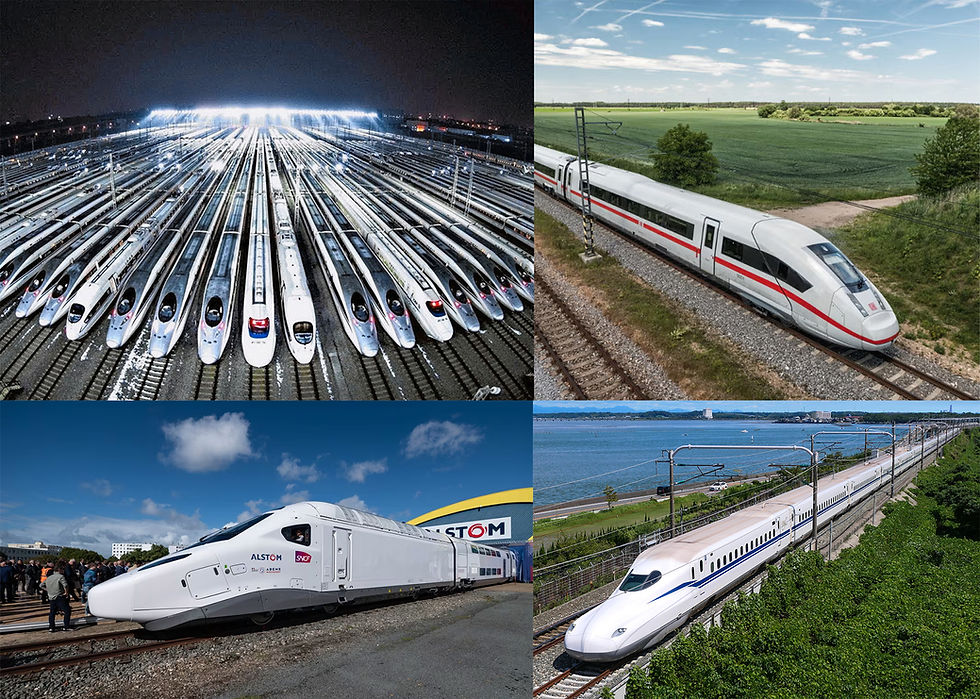
While the U.S. seems stuck endlessly updating legacy systems, other countries are pouring resources into 21st-century infrastructure—especially in transportation. Japan’s Shinkansen bullet trains have been running since 1964 and continues to evolve, with trains that arrive within seconds of their scheduled time. China has built the largest network of high-speed rail in the world in just over a decade. France’s TGV, Germany’s ICE, South Korea’s KTX—these aren’t just trains; they’re proof that modern transportation doesn’t have to mean compromise.

Meanwhile, in the U.S., we spend years debating whether we should fix century-old subway tunnels or replace rusted-over Amtrak bridges. Our idea of “innovation” often involves slapping Wi-Fi on a train that still averages under 60 mph, then calling it a revolution. We’ve convinced ourselves that we’re still leaders in progress, but too often we’re just coasting on the fumes of past achievement. Where once we built for the next hundred years, now we patch for the next election cycle. Big ideas get trapped in political gridlock, worn down by bureaucracy, underfunded by a Congress more interested in optics than outcomes. And when public-private partnerships do arise, they're often less about public good and more about profit margins. The result? False starts, broken promises, and headline-chasing ventures that fade before ever reaching the public. We cling to nostalgia while the world builds the future in real time. It’s a hard truth to face. But it is the truth. And maybe that’s why it stings—because deep down, we know we’re capable of more. We know we’ve let the bar slip, made peace with the mediocre, and convinced ourselves that pointing out the cracks is unpatriotic. But this isn’t cynicism. It’s accountability. You can’t fix what you refuse to see.
But here’s another truth—one that matters just as much: America hasn’t stopped dreaming. But we have stopped building at the scale our dreams demand. And while we debate, delay, and deflect, the rest of the world is racing ahead. Not because they’re smarter, or more visionary—but because they’ve chosen to act.

Other countries are showing us what's possible when there's commitment, investment, and a vision that extends beyond the next election cycle. Japan’s Shinkansen isn’t just fast—it’s precise to the second. I’m talking, you could set your watch to it, finish a bento box, and still have time to be amazed at how quiet it is. No delays, no mystery platform changes, no frantic dashes between terminals. It’s like a masterclass in what happens when you actually invest in infrastructure. In South Korea, the KTX rail network connects major cities like Seoul and Busan at jaw-dropping speeds, all while maintaining a sleek design and making transfers a breeze. Their trains don’t feel like budget options—they feel like a first-class future we never signed up for. Then there's the Netherlands and Germany, where biking infrastructure isn’t just a fun urban quirk—it’s a national priority. Entire cities are designed with bike commuters in mind. Dedicated lanes, connected trails, traffic signals specifically for cyclists. It’s the kind of setup that makes you wonder why we’re still arguing about whether painted bike lanes count as progress. And Norway? They’re out there operating fully electric ferries. They're building long-distance EV charging corridors, as well as wireless EV charging roads like it’s no big deal. It’s like they got the climate change memo early and actually read it instead of filing it under "Things to Do Later, Maybe."

And here in the U.S., we’re not without signs of hope. It’s easy to feel jaded, but if you zoom in, you’ll find progress bubbling up in places you might not expect. Cities like Seattle and Denver have been expanding their light rail systems. Los Angeles—yes, traffic-clogged L.A.—has been investing in new subway lines and dedicated bus lanes with real-time tracking. Even Phoenix, a city once proudly built for the car, is rethinking its sprawl with walkable neighborhoods and bike infrastructure. Amtrak, while often the punchline to a reliability joke, is making real upgrades in the Northeast Corridor. It’s not flashy, but it’s a start. Projects like the Gateway Program between New York and New Jersey or plans to electrify routes across the country show that momentum is possible—even if it’s slow and running a few decades late. And at the federal level, there’s movement too. The CHIPS Act is meant to bring semiconductor manufacturing back home—a huge deal for everything from clean energy to transit tech. The Inflation Reduction Act, despite its name sounding like it was cooked up in a beige conference room, might end up being one of the most consequential climate bills in U.S. history. It’s pushing billions toward electric vehicles, grid upgrades, and domestic clean energy innovation.

There’s also something else happening—something harder to quantify but just as important. People are starting to want more. Younger generations are growing up without the same car-centric mindset. They want cities where they can walk, bike, and breathe. Where commuting doesn’t feel like punishment and public transit isn’t treated as a last resort. Urban planners are listening. So are some mayors. So is the market. It’s not a full transformation yet—but it’s a pulse. A heartbeat. A reminder that progress doesn’t always come in sweeping revolutions. Sometimes, it starts with a protected bike lane or a city council vote. Sometimes it’s a train that runs on time, or a bus that feels clean and safe. And sometimes, that’s enough to keep the dream alive.
Reclaiming the Dream

We may not be living in the Jetsons’ future just yet. But that doesn’t mean we stop trying. I’ve been rewatching that show with my six-month-old daughter lately—sharing the cartoons I loved growing up. And even now, decades later, those silly sound effects and floating sidewalks still stir something in me. The world of the Jetsons was outrageous, yes—but it was also rooted in hope. In imagination. It dared to ask: what if?
What if work could be done in seconds? What if cities floated in the sky? What if commuting took a matter of moments, not hours? What if machines could serve us instead of the other way around? The Jetsons was a cartoon, sure—but it reflected something real: a culture that believed in possibility.

And maybe it’s silly, but one of the most vivid reminders of what we could have—what’s still possible—didn’t come from a tech demo or government report. It came from Jurassic World: Dominion. In the film, the biotech giant Biosyn uses a Hyperloop-style system to move people and cargo underground, seamlessly and silently. It’s not treated like some futuristic marvel. No one stops to gawk. It’s just… normal. Functional. And that hit me harder than I expected. Because seeing that concept—one we’ve heard about for years—brought to life so casually on screen made me feel something I hadn’t felt in a while: wonder. Not because it was science fiction, but because it didn’t feel like fiction at all. It felt like a version of our world we could have built by now if we’d followed through. If we hadn’t let the marketing outrun the engineering. We’ve visualized these ideas so clearly in our imaginations, in our films, in our design renderings—that we already know what they’d look like. We just haven’t found the courage, or the leadership, or maybe the collective will to make them real. Thinking about that, and seeing a hyperloop concept in motion in Jurassic World: Dominion, reminded me of another moment—a different film that hit me in a surprisingly personal way: The Martian.
One of the reasons we go to the movies is to escape reality. We want to see a world that’s different from ours—sometimes better, sometimes worse. But lately, I’ve noticed how often people throw around the word “unrealistic” like it’s a deal-breaker. Like it’s the only standard a story should live up to. But if that’s all we want—total realism—then there’s no room for possibility. No room for wonder. No room for what if. And frankly, if I want full realism, all I have to do is walk outside. It doesn't get more real than that.
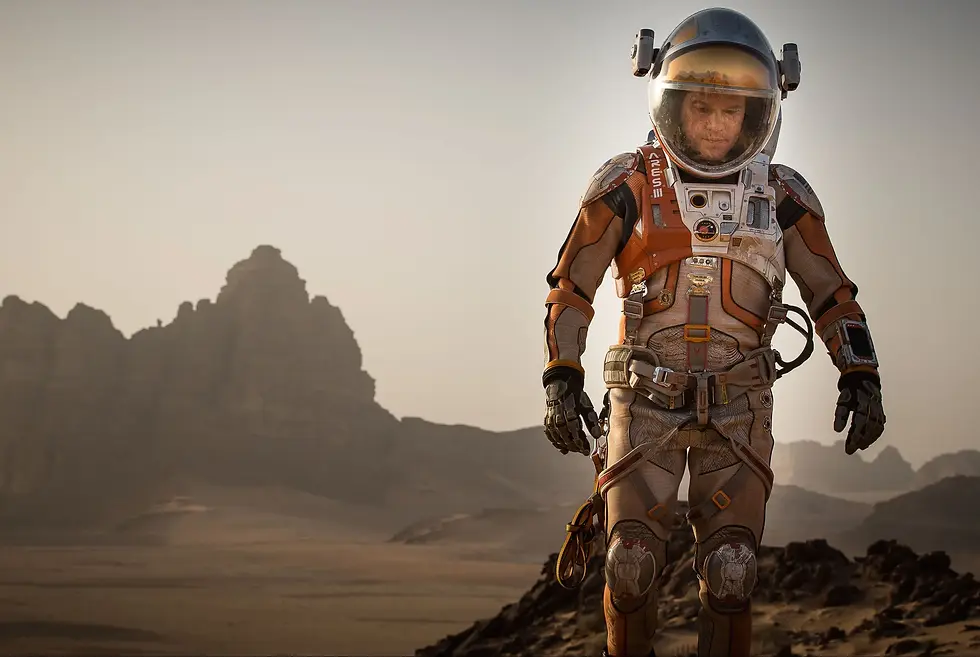
What I loved about The Martian was that it was grounded enough to feel real, but bold enough to ask “what if.” It showed us a world not so far from our own, and then nudged it just enough to imagine something better. What if, in a moment of crisis, the entire world worked together to save one person? What if China stepped in to help the U.S., not for leverage, but out of mutual humanity? What if science, cooperation, and compassion were the forces that united us—just this once? Yes, I get it. These things may not seem realistic. But they’re not impossible either. And that’s the point. The movie’s message wasn’t about the likelihood of those events—it was about the potential. The hope. The belief that in a fractured world, we still might find common ground. That in the face of overwhelming odds, we don’t give up—we work the problem. Together.
And that hit me hard.
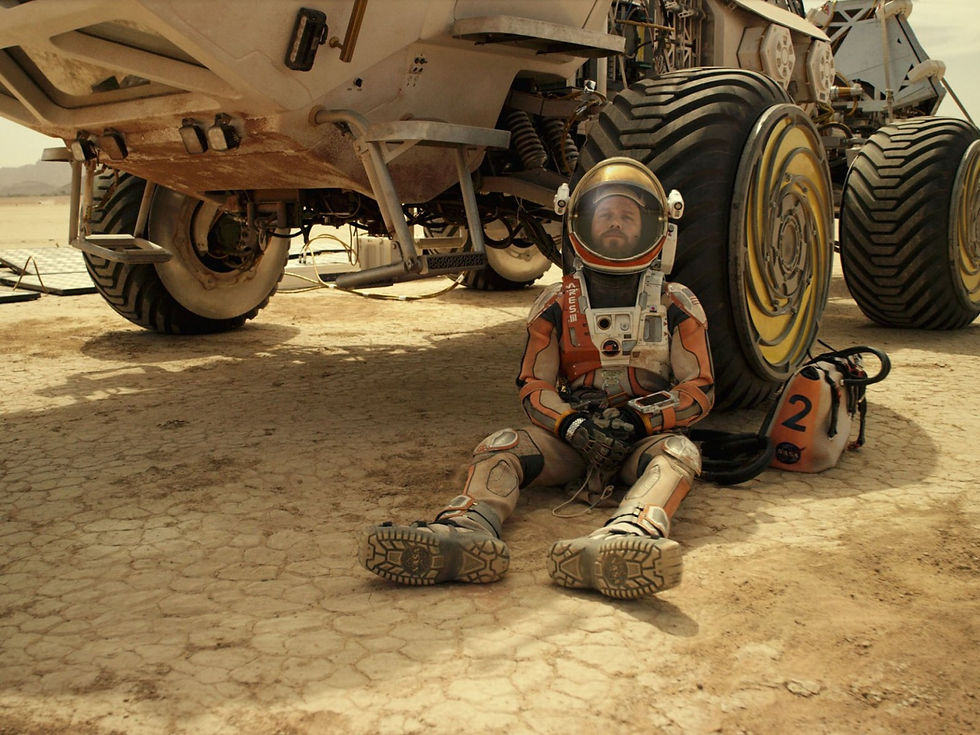
Most people that I know who saw this movie said they would’ve given up if they were stranded on Mars like Mark Watney. But that’s exactly why his story matters. He didn’t. He said, “I’m not going to die here.” And through his journey—the small wins, the crushing setbacks, the resourcefulness—it reminded us that even in the darkest corners of the galaxy, there is still hope. But it also reminded us that he wasn’t alone. People on Earth—scientists, engineers, diplomats, flight directors—all used their own skills to contribute to the solution. It wasn’t just science fiction. It was science, grounded in realism, with just enough imagination to make you believe. And in a time when cynicism seems to be the default setting, I found that incredibly refreshing.
And then there’s Mars.

We haven’t set foot there yet, but The Martian gave us a glimpse of what it could be like—a vision grounded not in fantasy, but in science.

The kind of science NASA and SpaceX are actively pursuing, from Artemis missions preparing us for deep space to Starship prototypes being built with Mars in mind. It reminded us that when courage meets cooperation, and science meets imagination, even the impossible starts to look achievable. It made space exploration feel tangible. Attainable. The Hermes—the ship in the film—doesn’t exist yet, but it’s based on real, modern concepts. It showed us a version of the future that isn’t just possible—it’s within reach, if we stop fighting each other and start building together.
In the end, The Martian was about more than one man’s survival. It was about not giving up. About rising to the challenge. About working together. And once again, it made me feel something I hadn’t felt in a long time—hope and wonder. Something I still long to feel.
“You just begin. You do the math. You solve one problem. Then you solve the next one and then the next. And if you solve enough problems, you get to come home.” - Mark Watney
This movie reminded me that we can come home. We just have to be willing to do the work. If we can imagine survival on a distant planet, surely we can reimagine dignity here on Earth.
Somewhere along the way, though, we stopped reaching for that kind of unity. Between our always-on schedules and endlessly delayed flights, we lost sight of what can happen when ingenuity meets collaboration. We stopped imagining what we might achieve together. In its place, we accepted discomfort as normal, delays as expected, and scaled-down ambition as wisdom. But maybe… it’s time to remember what we’re capable of.
I didn’t set out to write this after some lofty thought experiment—I wrote it because of a flight delay.

Because of cramped seats, confusing gate changes, and a long, exhausting day that somehow managed to wear down both my patience and my optimism. But somewhere in the shuffle of missed connections and gate announcements, my mind started to wander—first to what flying used to feel like, then to what it could feel like. To what transportation, and infrastructure, and the American spirit used to be. And maybe that’s the part that hurts the most. Not that everything’s terrible now, but that we used to aim higher. We used to build things that amazed the world—and amazed ourselves. Now we’re handed a cold bag of pretzels and told to be grateful it came with Wi-Fi. But here’s the thing: that spark of possibility? It’s still there.
I see it in the faces of the people who do dream, in the movies that dare to imagine something better, and in the engineers, the thinkers, and the artists still pushing for a future worth building. It made me realize—maybe that’s the whole point… not to return to the past, but to reclaim the feeling. The spark. The willingness to look up and believe again. Not just for me, but for anyone who's ever stared out a window and seen a future worth chasing. We don’t need to settle for “good enough.” We can aim for better. More humane. More ambitious. More connected. We just have to remember how to wonder again—and be brave enough to act on it. All it takes is a little courage, a lot of cooperation… and maybe just one more person who refuses to give up.
Thanks for reading.
Sincerely,
Nathaniel Hope


Damn fine read sir! You're absolutely right on the transportation front. Many countries are leagues ahead of us and it makes zero sense. The most sense is a point you made is how much can they take before one breaks so they can make as much as possible off them. No innovation has occurred in the US for a pretty extended period of time. Most we've innovated on is military weaponry and general electronic stuff. Kind of sucks. I'd love to be able to visit faster and more freely to my closest people outside the state I live in. Too expensive for a low grade experience whether its by plane, train, or automobile.