
Playing Old Worlds with New Eyes: Rediscovering the Wii U and Hyrule Warriors in 2026

Updated: Apr 10
For my birthday last year, I finally got a 65-inch LG 4K OLED TV. I promise I am not boasting. It just genuinely felt like a milestone for me because it is my first 4K television.

I tend to use TVs until the wheels fall off, and the funny problem I keep running into is that mine simply refuse to die. I still have an Insignia 1080p LCD with just about every input you can imagine, and it is somehow still going strong. It lives upstairs in the bedroom now, while my old 1080p Samsung plasma has found a second life in the master bedroom. Both of them are still great televisions, even today, and I am grateful they continue to work. They still serve their purpose, whether that is game streaming or something comforting to throw on in the background. But having a 4K OLED TV in the living room feels different. It feels like closing a small personal loop. I have been thinking about what it would be like to own a 4K TV ever since they first debuted on showroom floors, back when I was working in the Home Theater department at Best Buy.

That was well over a decade ago now, and finally bringing one home makes the moment feel quietly meaningful. Back then, 4K felt like this distant, aspirational thing. Technology has come a long way since then. Going from LCD to LED was a huge leap, but when 4K OLED entered the picture, it genuinely changed how displays felt. It stopped being about counting pixels and refresh rates and started being about presence. Deep blacks. Rich contrast. Colors that actually feel alive. For me, OLED reminds me of the best parts of plasma TVs, those inky blacks and saturated colors, but with the benefits of modern display tech. More energy efficient. Sharper. Brighter. Cleaner. It is the kind of upgrade you do not fully appreciate until you live with it for a while. I have had this TV for nearly a year now, and it still makes me stop and say “wow.” Not because it is new anymore, but because it continues to feel special. Shows and movies look absolutely incredible. But what really caught me off guard was that some of the biggest “wow” moments have come from playing video games.

And not just flashy PS5 titles with all their modern graphical bells and whistles, although those do look amazing. I mean, seriously, the Resident Evil 2 remake already looked great on my older displays. On this new 4K OLED, though? Wow. It has never looked better. What surprised me even more, in the best way, was how good older consoles can look on this display, at least the ones I have tried that use HDMI. The TV’s built-in upscaler does a lot of quiet, invisible work. Lower resolution games get cleaned up, edges look smoother, and when you pair that with an OLED panel, the colors suddenly feel richer and more vibrant than I ever remember them being. The TV itself is so thin and unobtrusive that it almost disappears. All I really see is the screen, a massive slab of OLED with almost no frame to speak of. Suddenly, these games I have known for years, games I once played on a 27-inch CRT TV or a 1080p 42" LCD TV, feel huge and strangely new again, as if I am seeing them for the first time.
All of that led me back to my Nintendo Wii U.

The Wii U has always felt like a console with an identity crisis. Even at launch, its name confused a lot of people, and many did not realize it was a brand-new system at all. The console itself looked similar to the Wii, and Nintendo placed so much emphasis on the GamePad that a surprising number of people believed the tablet was either the console itself or just an accessory for their existing Wii. If you look back at the Wii U announcement trailer from E3 2011, you can see how much of Nintendo’s messaging centered on the GamePad rather than the system as a whole. I saw that confusion firsthand when I was working at Best Buy. A big part of my job ended up being less about selling the Wii U and more about explaining what it actually was.
In hindsight, it is easy to see how that messaging misstep hurt the system. Nintendo would go on to find massive success with the Switch, which not only redefined their hardware approach but also reshaped their online ecosystem in ways the Wii U never really benefited from. In many ways, the Wii U feels like the awkward bridge between eras, a console full of interesting ideas that never quite found its footing with the wider audience. Coming back to it now, that awkwardness feels less like a failure and more like a fascinating snapshot of a company trying to find its next identity. And yet, coming back to it in 2026, it feels oddly ahead of its time.

One of the Wii U’s greatest strengths is its versatility. By the end of its life, it had quietly become a hub for multiple generations of Nintendo history. NES, SNES, N64, Wii, DS, GBA, and more all lived under one roof. At the time, that kind of access to Nintendo’s back catalog felt impressive. Looking at it now, in an era where digital storefronts vanish and libraries disappear overnight, that versatility feels even more valuable. The Wii U, for all its commercial missteps, ended its life as one of Nintendo’s most quietly generous consoles. Thanks to the modding and homebrew community, that legacy has only grown stronger. What was once a closed system has become something far more flexible and alive. You can back up your own physical library, run games directly from external storage, experiment with emulation, reconnect to community-run online servers, and unlock features Nintendo fans had been asking for since the console was first revealed. Things like custom themes, small quality-of-life tweaks such as faster boot times or handy system shortcuts, expanded GamePad functionality like remapped controls and taking screenshots, and preservation-friendly tools. All of these things make the Wii U feel less like a forgotten footnote and more like a living piece of hardware history. In that sense, revisiting it now feels less like booting up an abandoned console and more like uncovering a strange, fascinating time capsule from a period of my life I had not thought much about in years.
It was misunderstood in its moment, but in the long shadow of the Switch, it finally feels free to be appreciated for what it actually was. A weird, ambitious, deeply flawed machine that, with time and community support, has quietly become something special. And it is because of that, and the love and support the Wii U has received from the gaming community over the years, that I finally decided to dive in and jailbreak, or, 'open up', my own system.
Giving the Wii U a Second Life
Unlocking the console feels surprisingly wild in a quiet, nerdy way. There is something deeply satisfying about using homebrew tools to install many of my physical games onto an added 2TB hard drive. It is one of those small, quietly nerdy things that just makes me grin. This is a system that originally launched in two models, an 8GB version and a 32GB version. The idea of running a 2TB drive on a Wii U in 2026 is so wildly out of proportion that it honestly makes me laugh.
There is also something genuinely comforting about knowing my physical library is preserved with less wear while still being instantly accessible. I still love that the system will read the discs if I ever want to go that route, but having everything backed up and ready to play at a moment’s notice makes the whole experience feel smoother, friendlier, and oddly future-proof for a console that was once written off as a failure.

Paired with my new LG OLED TV, this setup has let me experience familiar games in a completely new light. The first two games I tested were ones that are still technically stuck on the Wii U: The Legend of Zelda: Wind Waker HD and The Legend of Zelda: Twilight Princess HD. For years, the community has hoped Nintendo would bring these HD versions to the Switch, especially after Skyward Sword received the HD treatment. But as of this writing, nothing has come of it beyond rumors and speculation. Coming back to these games after all this time and seeing them on a modern display genuinely caught me off guard. I already loved these remasters, but seeing them upscaled on a 65-inch OLED made me unexpectedly emotional. They did not just look “good for their age.” They looked striking. Fresh. Alive in a way that made me want to linger in those worlds longer than I had planned, as if I were seeing them for the first time again. That little rediscovery spiral did not stop with those two games. Once I saw how good familiar Zelda worlds could look on this setup, I started hopping between titles, just to see what else might surprise me. What I found ended up exceeding my expectations in the best way.

There are plenty of other games that deliver that same sense of visual pop on this display. Mario Kart 8, Super Mario 3D World, New Super Mario Bros. U, Super Smash Bros. Wii U, and Donkey Kong Country: Tropical Freeze, just to name a few. They all hold up beautifully, with clean art direction and bright colors that upscale surprisingly well. They were stylized enough at launch that modern displays actually flatter them. Other games land in more of a middle ground. Splatoon and Pikmin 3 still look great artistically, but you begin to notice the softer edges and lower resolution once they are stretched across a large 4K screen. The Legend of Zelda: Breath of the Wild benefits massively from its art style and lighting, but even there, the visual gap between the Wii U and Switch versions becomes hard to unsee. In some ways, Wind Waker HD and Twilight Princess HD end up looking better on Wii U than Breath of the Wild does on the same hardware, which is a fascinating contrast. I eventually learned why.
Breath of the Wild is locked at 720p and 30fps on Wii U, while Wind Waker HD and Twilight Princess HD run at a native 1080p and 30fps. The decision was clearly made to prioritize consistent performance over higher resolution on aging hardware. Breath of the Wild arrived on Wii U at the very end of the system’s lifecycle, and in that context, the compromise makes sense. It is not terrible by any means. It is just noticeable, especially when my first experience with the game was on Switch, where it runs at a higher resolution. Even so, the fact that Breath of the Wild runs on Wii U at all still feels nothing short of remarkable. I'm even considering doing a full playthrough on this system because the concept of playing such an amazing game on older hardware sounds like it could be fun.

Beyond that, there are some games that feel more passable. Not bad, but very much products of their era. Stuff like Nintendo Land or ZombiU still plays fine, but visually you can tell they were built with different assumptions about screen size and resolution. The upscaling helps, but it cannot fully hide the seams. You see more jagged edges, softer textures, and environments that feel a little emptier than you might remember. But that is also what makes this console so special. There is a certain charm in revisiting older hardware through modern tech, limitations and all. Sometimes the upscaling works wonders. Other times, it simply reveals the seams. Even so, what caught me off guard was not just how these games looked, but how good it felt to be back on the Wii U at all. The last big memories I had with the system were Super Smash Bros. Wii U and Mario Kart 8. I had not spent meaningful time with it in over a decade. Suddenly, here I was, rediscovering this odd little console and watching modern display tech breathe new life into it in ways I could never have imagined back when it first launched. That context made the next discovery hit a little harder.
An Unexpected Standout

One of the other games I tested was Hyrule Warriors. I booted it up mostly out of curiosity, more as a visual experiment than anything else. Like Wind Waker HD and Twilight Princess HD, I ended up being genuinely impressed. Running at 720p and around 30 frames per second, Hyrule Warriors lands somewhere between “pop” and “really good” visually, especially on this display. I was particularly struck by how well the TV handled the upscale, along with the richness and depth of the colors.

Now, I am fully aware that the game eventually received a Definitive Edition on the Nintendo Switch in 2018, which is clearly the best way to play it. It combines content from both the Wii U and 3DS versions into a more polished package with higher resolution and smoother performance. On paper, that difference sounds dramatic, and I am sure it looks gorgeous on a 4K OLED. In practice, though, with my TV doing a lot of the heavy lifting, the Wii U version still managed to surprise me in ways I did not expect. What caught me even more off guard than the visuals was how quickly that casual test session turned into genuine interest. I did not just see a game that looked better than I remembered. I found myself wanting to stay there and actually play. Around the same time, my wife had been enjoying the newer Hyrule Warriors game, Age of Imprisonment, on the Switch 2, which nudged me to finally give the original a real chance. Sure, I could have booted up the Definitive Edition on the Switch. That version exists for a reason. But I had just unlocked my Wii U and was experiencing this console in a new way. I did not want to play the “better” version of the game, at least not right now. The Wii U version was the original proof of concept. It was also the first time Nintendo teamed up with another studio to create something like this. Opening up my Wii U made me want to meet the game where I had first ignored it and give it the time I never did back then.

When it first released back in 2014, I wrote it off. I do not know if it was because it felt like a strange spinoff, or because I had no real interest in Dynasty Warriors style games. Either way, I dismissed it without much thought and moved on. Coming back to it now feels strangely fitting for where I am in my gaming journey. I have grown more open to different genres and more willing to meet games on their own terms. Honestly, if I could yell at my past self, I probably would. I would tell him he is missing out on one of the most fun Zelda-adjacent experiences I have ever had. Before I set out to write about my experience with this game, I was only planning to post a short blurb in my Discord community. One of those quick “Hey, I played this and really liked it” kinds of posts. But as I started to write, time flew by, and I realized I had already written more than two pages. Turns out this game had more of an impact on me than I expected. I fell into a different rabbit hole without even realizing it. That realization is what brings me here, which, in its own small way, feels kind of perfect.
Now, for the record, I have only completed the main story campaign. I know I have barely scratched the surface when it comes to how much content this game offers. That said, the main campaign is the meat and potatoes of the experience, the core that shapes its version of Zelda’s narrative in some really interesting ways. This is not a full review. I still have characters to unlock and entire modes to explore. But as with most of my writing about games, this is less about evaluating the product and more about unpacking my own experience with it.

So with that in mind, let us dive in.

One of the biggest surprises for me was not just the sheer number of playable characters, but how much perspective the game brings to Zelda lore. Characters who once felt like supporting figures suddenly feel tangible and powerful in your hands. Each one has weight. Each weapon feels right. Playing as Link is exactly what you would hope for. Fast, precise, heroic. But switching to Impa or Zelda changes the rhythm entirely. You start to feel how differently these characters move through combat, how their personalities and roles translate into their fighting styles. Not to mention, just how powerful some of them really are.

One of the biggest surprises for me was Darunia, Link’s sworn brother from Ocarina of Time. Aside from wearing the Goron Mask in Majora’s Mask, I had always wondered what it would actually feel like to play as a Goron. Now I finally had my answer. He is slower than Link, but built for raw power. Watching him plow through crowds of enemies with his giant hammer is immensely satisfying. Where Link feels agile and surgical, Darunia feels like a straight-up tank. When his hammer slams into the ground, it feels less like an attack and more like artillery fire, leaving a crater in its wake. And that is just Darunia. With the sheer number of characters available, you can feel the care put into each one. Their signature moves, their special attacks, even the way they move across the battlefield all reflect who they are. But there was something else that completely caught me off guard. Something I did not anticipate. You do not just play as the heroes. The game also lets you step into the role of the villains, seeing the battlefield from their perspective.

Ganondorf, the embodiment of evil in this world and throughout much of the Zelda franchise, is not just a boss or a looming presence. He is a fully playable character.
That, to me, is absolutely wild! Sure, you get a taste of him in Super Smash Bros. Melee and the entries that followed. It is fun to control him there. But in Hyrule Warriors, you do not just play as Ganondorf. You inhabit that power fantasy. He does not simply hit hard. He feels overwhelming.
There is something almost absurd about wiping out hundreds of enemies with the casual press of a few buttons. Ganondorf makes devastation look effortless, and being evil feels far more fun than I ever expected. That is what makes a game like this so compelling. You step into the shoes of both hero and villain, and it reframes the story in a way the mainline games never quite do.

What really stuck with me, though, was the scale of it all. You are not just cutting through faceless foot soldiers. You are plowing through entire waves of Hyrule’s races. Hylian soldiers. Gorons. Groups that, in the core Zelda games, are usually portrayed as communities, not cannon fodder. I have never seen Zelda depict its world at that kind of scale before. Seeing hundreds of Gorons on the battlefield at once makes the world of Hyrule feel vast and populated in a way the series rarely gets to show. But stepping into the role of someone powerful enough to mow them down by the dozens is unsettling in a way that feels intentional. It reframes Ganondorf not just as a villain you oppose, but as a force of destruction you briefly get to embody. That contrast adds a strange weight to the fantasy, one that made me pause and think about how differently the world feels depending on whose boots you are standing in. But even on the opposite end of the spectrum, the variety of enemy encounter types is incredible. Bokoblins, Stalfos, Moblins, Lizalfos, Gibdos, Big Poes, just to name a few. Seeing enemies pulled from all different corners of the Zelda series, not just present but appearing by the hundreds, is wild in the best way.

It is one thing to fight a handful of these creatures in a traditional Zelda dungeon. It is another thing entirely to face down an entire army of them on an open battlefield. That scale changes the feeling of combat in a really satisfying way. When you are playing as a hero and you are surrounded by waves of familiar monsters, the experience becomes less about careful, methodical encounters and more about momentum. You are not just surviving. You are carving a path through chaos. It is chaotic, overwhelming, and strangely exhilarating. Seeing the world of Zelda expanded to this size makes Hyrule feel less like a series of small, isolated spaces and more like a living land filled with endless conflict, and being dropped into the middle of that storm is a thrill I did not realize I wanted from this universe.
Peeling Back the Layers
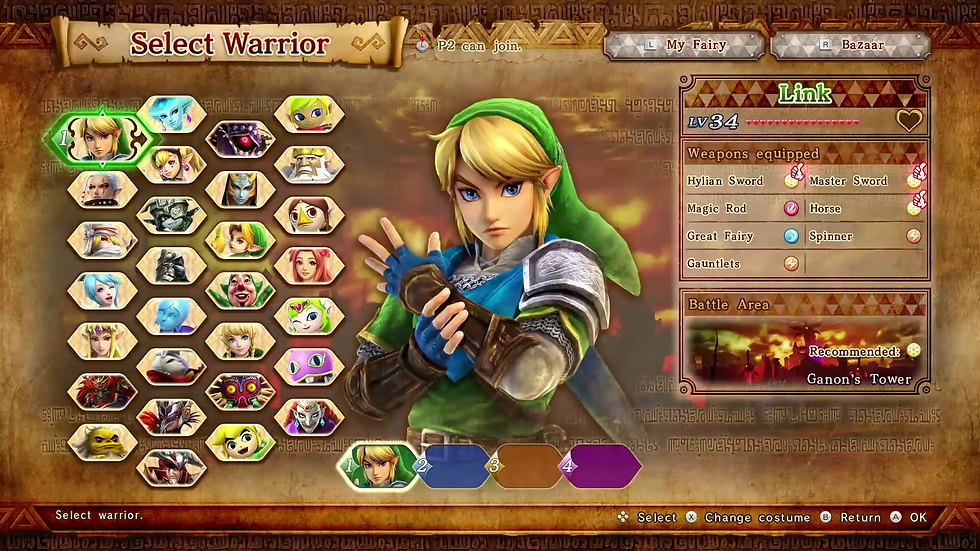
What I ended up loving most about the main campaign is that it forces you to step outside your comfort zone. You do not get to just play as Link the entire time. The game nudges you to embody different characters, and in doing so, you gain a better sense of how each one fits into the larger world. While the basic button combos remain familiar, the magic abilities, special attacks, and finishing moves give each character a distinct flavor. What really mixes up the formula is the progression loop. The more you play, the more you unlock. New weapons, new abilities, stat upgrades that affect attack, defense, and support. All of it is tailored in ways that reflect the characters’ origins in the Zelda series. It is the kind of fan service that does not feel shallow. It feels thoughtful. It feels like it was made by people who genuinely love this world and understand why longtime fans do too. It also encourages experimentation. The more you play as different characters, the more items you collect, and the more the game opens itself up to you. Even when the main campaign is finished, the experience itself is far from over.

That realization hit me once I started digging into the different modes. Legend Mode is the main story campaign, the cinematic throughline that reimagines key moments and ideas from across the Zelda timeline. It is the structured, guided experience that introduces you to the mechanics, the characters, and the tone of the game. Free Mode feels like the training wheels coming off. It lets you replay story missions with any character you want, which sounds simple on paper but completely changes how those battles feel. Revisiting a familiar mission as a character who was never meant to be there adds a playful “what if” energy that makes experimentation part of the fun. Then there is Adventure Mode, which is where I realized just how deep this rabbit hole goes.

Instead of a linear story, you are dropped into a board game-like map filled with individual challenges, side battles, and puzzles. Each tile becomes its own little scenario, sometimes asking you to complete objectives under pressure, other times nudging you into grinding for materials, weapons, or character upgrades. It feels less like a traditional campaign and more like a long-term playground, a space designed for players who want to live inside this version of Hyrule for a while. By the time I understood how all these modes fit together, it became clear that finishing the story was not the end of the experience. It was more like the moment the game finally hands you the keys and quietly says, “Now go see how deep this goes.” What really filled my cup with joy was realizing that Adventure Mode’s map is literally the overworld from the original The Legend of Zelda on NES.

Seeing that familiar layout reimagined as a tactical board, wrapped in chunky 8-bit art, was one of those moments that made me pause and smile.

The pixel versions of the Hyrule Warriors characters running around that old-school map, mixed with classic items pulled straight from Zelda’s earliest days, feels less like simple nostalgia and more like a thoughtful celebration of the series’ roots. Then you realize it does not stop there. There is an 8-bit style Twilight map inspired by Twilight Princess. There is even a version of Termina from Majora’s Mask. Entire worlds, reinterpreted through the lens of retro aesthetics, turning decades of Zelda history into something playful and new. Taken together, all of these maps, modes, and layers of detail start to feel like more than just bonus content. The easter eggs, the visual callbacks, the sheer volume of loving references make Hyrule Warriors feel like a celebration of everything Zelda has been, everything it has become, and everything it means to the people who have been traveling through Hyrule for years. Experiencing that now, long after I initially dismissed the game, has been unexpectedly moving. It feels less like I am just playing a spinoff and more like I am walking through a living museum of a franchise that has quietly shaped so much of my gaming life.

Seeing that NES map again did not just remind me of an old game. It reminded me of who I was when I first stepped into Hyrule, when discovery felt endless and every secret felt like it belonged to me alone. Experiencing that same world now, filtered through layers of modern design and fan service, felt like looking at a childhood memory through adult eyes. The shape is familiar, but the feeling is different, deeper somehow. I found myself appreciating the smaller details in ways I never would have before. As you complete challenges, more of the map slowly reveals itself, uncovering secrets along the way. It becomes a game within the game, a quiet rhythm of exploration layered on top of the chaos of battle.

The rewards feed back into the rest of the experience, strengthening your characters not just for Adventure Mode, but for Free Mode and Legend Mode as well. Each new upgrade makes the next challenge feel more achievable, and each completed challenge opens the door to even more possibilities. It is a loop that is undeniably addictive, but also strangely comforting, a system that gently encourages you to keep going without feeling punishing. What surprised me most is how naturally that loop plays into my long-standing love for this franchise. It is not just about grinding numbers or chasing better stats. It is about being nudged to spend more time in a version of Hyrule that feels both nostalgic and reimagined, familiar yet quietly new. In those small, meaningful moments of progression, the game finds ways to remind me why this world has stayed with me for so long.
Opening More Than a Console
It is kind of crazy thinking back to where the Wii U was when it first launched compared to where it is now, thanks to the passion of its community. There is something special about revisiting an old console and replaying favorite games. But there is something even more meaningful about discovering games you missed and realizing how much joy you left on the table back then. I briefly considered jumping over to the Definitive Edition of Hyrule Warriors after spending time with the original. But after completing the main story campaign and sinking more hours into Free Mode and Adventure Mode, I felt pulled in a different direction.

Instead of moving forward to the “best” version of the game, I found myself wanting to look sideways. That curiosity led me back to another older console entirely, the Nintendo 3DS. Hyrule Warriors Legends lives there, and while it shares the same core DNA as the Wii U version, the experience is surprisingly different in ways that made revisiting it feel worthwhile. On paper, Hyrule Warriors Legends is essentially the same game. Same story beats. Same core combat loop. But in practice, playing it on the 3DS changes the entire texture of the experience. The most obvious difference is scale. What feels sweeping and cinematic on a big screen becomes intimate and condensed on a handheld. Battles feel more personal, less about spectacle and more about moment-to-moment management. The smaller screen and lower resolution soften the visual punch, but they also make the chaos easier to parse in short bursts. It becomes a game you dip into rather than sink into.
The performance differences are noticeable too. Where the Wii U version leans into larger crowds and a sense of overwhelming scale, the 3DS version feels more restrained, sometimes by necessity. Enemy counts are lower. The frame rate is less stable. And yet, there is something charming about having this sprawling, over-the-top Zelda spinoff living inside a portable device.

It feels like a technical magic trick, even with its compromises. What surprised me most is how differently the game fits into my life depending on the platform. On the Wii U, Hyrule Warriors feels like something you sit down with, commit to, and let wash over you. On the 3DS, it becomes something you chip away at. A mission here. A battle there. The same game, filtered through two very different rhythms of play. I have not quite finished the 3DS version yet. I have been taking my time with it. But in those quiet moments when I am lying in bed, it has been genuinely comforting to knock out a mission or two before it is time to sleep. There is something small and peaceful about that ritual, a reminder that games do not always have to be big events to matter.
If there is one word that sums up my experience opening up my Wii U and rediscovering Hyrule Warriors, it is gratitude. I finally fulfilled a curiosity I had carried for years but never committed to. I found joy in the simple act of playing, in discovering small, thoughtful details within a franchise I care deeply about. I even found myself wanting to venture deeper, to see how this same experience translated to the 3DS version, approaching it with the same curiosity and openness that drew me into the console version. And if I'm being honest, I'm toying with the idea of playing a Dynasty Warriors game at some point to see what else I have been missing.

With all the rediscovery and reflection that came out of this, there was one moment I never saw coming. During one of my random Hyrule Warriors playthroughs, my wife told me she genuinely enjoyed watching me have fun. That comment stuck with me more than I expected. Somewhere along the way, this experience became about more than just playing a game. It became about reconnecting with a feeling. The joy of setting up a new piece of tech. The quiet excitement of bringing an old console back to life. The surprise of rediscovering something I had once brushed off without much thought. That is ultimately what I wanted to share here. Not a verdict on Hyrule Warriors, or a ranking of consoles, or a breakdown of features, but a small reminder of how easy it is to lose track of simple joy. If this reflection inspires anything, I hope it encourages you to revisit something you loved when you were younger, or to give a second chance to something you once dismissed. You might find that time, perspective, and a little curiosity can turn an old world into something quietly special all over again.
Thanks for reading.
Sincerely,
BlueNile101


fly88 mình cũng kiểu nghe người ta nói hoài nên bấm vào coi thử cho biết chứ không định ngồi soi nội dung gì nhiều. Vừa vào thấy giao diện khá dễ chịu, nền thoáng nên mắt không bị rối. Mình thích nhất là cách họ chia khối rõ ràng, nhìn một cái là biết phần nào nằm ở đâu, không phải kéo qua kéo lại mới tìm được. Mấy bảng thông tin trình bày theo cột nhìn gọn, lướt nhanh là nắm được ý chính, hợp kiểu chỉ ghé xem sơ. Menu đặt ngay chỗ dễ thấy nên chuyển mục cũng tiện, không phải mò. Nói chung cảm giác dùng ổn vì các khối nội dung tách bạch và…
https://keonhacai.cam/ mình mới tạt ngang vô coi thử vì thấy mấy đứa bạn hay nhắc, chủ yếu tò mò giao diện thôi. Vào cái là thấy bố cục khá sạch sẽ, nhìn một phát là biết phần nào là nội dung chính, phần nào chỉ là thông tin thêm, nên không bị ngợp. Mình lướt nhanh mà vẫn nắm được ý vì các khối nội dung chia ra rõ ràng, không phải kéo qua kéo lại để tìm chỗ đang đọc. Có đoạn nói về tải app mình thấy viết ngắn gọn, kiểu giải thích thẳng là dùng app thao tác nhanh và ổn định hơn so với trình duyệt, đọc cái hiểu liền. Nói chung cảm giác dùng ổn…
Cut 24 blank pieces on my Glowforge using the SVG puzzle template on 1/8 inch birch ply, kerf came out cleaner than the paid template I bought last year.
Bride wanted guests to sign each piece at the reception and it went over great.