
The Switch 2 Is Fine — But Is That Really Enough?

A personal look at Nintendo’s newest console, its awkward price tag, and why I’m not feeling the magic just yet.

If you’ve been following my blog for a while, you might remember I already shared some initial impressions in a post titled “Weighing In on the Full Picture — Blue’s Honest Take on the Nintendo Switch 2 Reveal.” Back then, we were reacting to the announcement, breaking down the trailer, the pricing, and the overall vibe of Nintendo’s presentation. I had my reservations even then — especially around the lack of a “wow” moment and the sharp jump in price — but I was still hopeful. Well, it’s been a few months now. Nintendo’s new console is finally out in the world for all to see, touch, play, and poke at like a curious Labo creation. And with all that said — guess who was lucky enough to snag one? This guy! We speculated. We hoped. We talked about what could be — the next chapter of Nintendo magic. And now that I’ve actually spent real time with the system? I’ve got a whole new set of thoughts to unpack. Let’s talk about how it all landed in reality.
Like any modern tech launch, I’m not gonna lie, trying to pre-order the system was a mess. My wife and I were bouncing between Target, Walmart, and Best Buy the night preorders went live. Target’s site practically exploded. I couldn’t add it to my cart on PC, but somehow managed to on mobile — only for checkout to fail over and over until Target unceremoniously emptied my cart and slapped me with a big ol’ “Out of Stock.” Thanks for the stress, Target.

Best Buy and Walmart at least had digital queues, so we each picked a lane and waited. My wife took Walmart. I went with Best Buy. After what felt like waiting in line for the Star Wars ride and Disneyland during our honeymoon, I got through. We had secured the console. Victory…But why is it still like this in 2025? This whole experience was just a reminder of how little progress we’ve made in making tech launches not suck. Giant corporations still can’t handle traffic surges. But that’s a rant for another day. Today, we talk about the Nintendo Switch 2!
So what are my thoughts?

Well...
It's...
Fine...
Dramatic, I know.
But seriously, it's just... fine.
And I don’t mean that in a sarcastic, “fine” (eyeroll) kind of way. I mean it in the most literal, neutral, "not bad, not great, just fine" kind of way. This new system is basically the Switch you already know. Just a bigger, sleeker, slightly more powerful version of the Switch you already know. The magnetic Joy-Con connection? Honestly, pretty slick. I like it much better than sliding the Joy-Con controllers on the old system. Handheld mode feels nicer, especially with the Joy-Con controllers being slightly larger. The screen itself is large and crisp — not OLED-beautiful, but definitely solid for an LCD screen. Games overall look good. Games run pretty well. So far, nothing has exploded, which is nice. And honestly, that’s about it.
I can imagine the way you're reading this, you're probably thinking to yourself "Wait, that's it?". Yeah, unfortunately. And I get it. My thoughts are very boring and uninspiring when I put it all together like that. But it's true. The system has the same interface and UI as the original Switch, it plays the same games as the old Switch, and there's honestly no jaw-dropping moment that I've had with this system that says “Oh my god, this changes everything” reaction. It's more along the lines of “Oh hey, that’s neat.” And: “Yeah, this feels nicer.” Which, to be honest, isn’t necessarily a bad thing. But it makes it really hard to feel excited.
Here’s what honestly stings: the price of this perfectly average experience.

As most of you already know, the standalone console runs $449.99. If you managed to snag the Mario Kart World bundle like I did, you’re looking at $499.99. That officially puts the Switch 2 into “premium console” territory — a full $200 jump over the original Switch’s launch price. And that’s before you factor in games or accessories. Missed the bundle? Mario Kart World on its own will cost you $79.99 — a pretty surprising move on Nintendo’s part, especially considering how they've priced first-party titles in the past.

Toss in a couple extra Joy-Con sets, maybe a Pro Controller, a Nintendo Switch Online subscription — and suddenly this wholesome little Nintendo handheld costs the same as a Steam Deck, a PS5, or a used 2003 Honda Civic with one working speaker, 187,000 miles, and an “I brake for Koroks” bumper sticker. Jokes aside, I’m no stranger to the world we’re living in right now.
It’s getting harder to justify the price of anything these days — let alone gaming — when the cost of everything keeps climbing while most paychecks really haven’t. You want to feel like the price of what you pay for is fair. You want your purchases to mean something. To carry value. To feel worth it. We’ve talked about the price of gaming plenty here before. Even before the Switch 2 was officially announced, pricing was already a hot topic — and for good reason. The moment Nintendo dropped that $449.99 tag (and $80 games on top of it), people started asking hard questions. Now that the console is here, we’re no longer speculating — we’re living it. And that means it’s time to have that awkward talk about value versus price. And right now? The value just doesn’t feel like it’s quite there. That’s the honest truth.

A system is only as good as the games it launches with. I feel this is where the Switch 2 stumbles a bit. Outside of Mario Kart World, there’s not much to write home about. Don’t get me wrong — there’s a decent amount of third-party support this time around, and that is something worth celebrating. Games like Cyberpunk 2077, Elden Ring, Street Fighter 6, Hitman: World of Assassination launching day one? That’s a big deal for Nintendo. But here’s the thing: Like many other gamers out there, I already own a lot of these games on Steam or PlayStation 5. I’ve played them. I’ve finished a lot of them. I’m not about to pay full price again just to have a less flexible, slightly more portable version on the Switch 2. Right now, I only own one game for the Switch 2 and that's Mario Kart World.
And when it comes to that game, I will say this:
It is absolutely fun.

The sheer amount of detail, the lighting, the size of the open-world hub — it feels like a leap for Nintendo. It’s honestly impressive what they’ve done to this game. There’s exploration, there’s freedom, there’s a fresh vibe to the usual Mario Kart chaos. It’s a solid evolution of the franchise, and honestly? I think it’s a contender to be one of the best entries in the series.
But is it worth $80?
Ehh…
Well...
No. Not really.
It definitely doesn’t feel like it should be THE main launch title for a brand-new console.

Back in 2017, the original Switch launched with The Legend of Zelda: Breath of the Wild — a game you could lose 100+ hours in. Genre-defining. Console-selling. Priced at $59.99. Mario Kart World? After an hour or two, I’m ready to move on. I’ll come back to it tomorrow, sure — drive a bit, race a few cups, call it a night. It’s enjoyable. That being said, it doesn’t really hook me. Breath of the Wild had me glued to the screen. I couldn’t put it down. That’s the kind of magic I was hoping for here. And maybe it’s unfair to expect that kind of depth from a Mario Kart game — they’re not built the same. Obviously. But when that’s the hill you plant your flag on at launch? You can’t be surprised when people start measuring it against the mountains that came before.
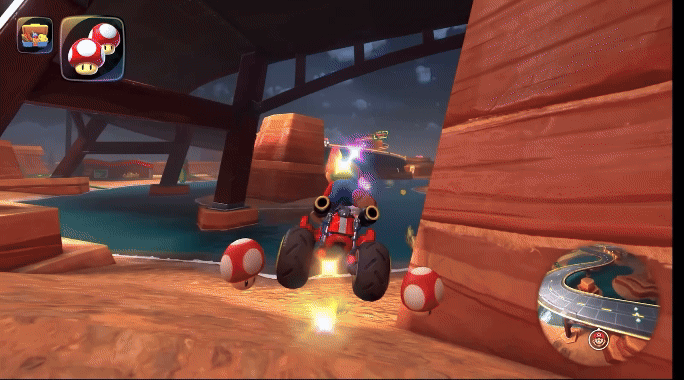
And maybe Nintendo knew that. Maybe that’s exactly why they’ve filled the launch window with enhanced versions of older Switch games — now bundled under the shiny new label of Switch 2 Editions. Between that, Mario Kart World, and a roster of third-party titles? Sure, it’s a launch. But it’s not a great launch. Not compared to what else is out there — or what’s come before.
If anything, I think it’s the Switch 2 Editions that quietly give this system a bit of an edge. And that’s something I want to touch on — because I don’t see many others talking about it.

The broader rollout of these Switch 2 Editions is actually better than I expected. For starters, The Legend of Zelda: Breath of the Wild and Tears of the Kingdom both offer a $10 upgrade if you already own the original. And if you’re a Nintendo Switch Online subscriber? That upgrade is included. No joke. That’s… weirdly generous — especially coming from the same company that charged full price for Twilight Princess twice in 2006 just because you owned both a GameCube and a Wii.

Remember that? Twilight Princess was originally developed for the GameCube, but the Wii version actually launched first on November 19, 2006 — with the GameCube version quietly following a month later like a politely forgotten middle child who still brought a solid science project to the fair. Both versions? Full price at $49.99. No bundles. No discounts. Just two separate boxes and a knowing wink from Nintendo that, yeah, you were probably going to buy both. And yeah… I did. But the reason why I did was because Wii consoles were impossible to find at launch — they were flying off shelves faster than a Cucco swarm after one too many sword swings. I was not about to wait around to play the latest Zelda game, so I picked it up on GameCube first. When I finally got my hands on a Wii, of course I bought it again. I had to know what the motion control buzz was about. And the verdict? Like the Switch 2, it was… fine. Aside from the mirrored layout and the occasional wrist-waggle sword slash, it was the exact same game. Twice. Full price. So honestly, seeing Nintendo offer a $10 upgrade for Zelda this time around actually feels… strangely generous. And that’s not something I see many people talking about when it comes to these upgrade paths.
Even better, Nintendo didn’t stop there. Several games are getting free performance boosts on Switch 2 with no rebranding, no new box art, and no extra charge. Just better frame rates, faster load times, and a little extra shine when you pop in your old copy. Titles like Super Mario Odyssey, Splatoon 3, Captain Toad: Treasure Tracker, and Zelda: Link’s Awakening all benefit from this.

Then there are the new hybrid releases — the ones labeled with “Switch 2 Edition + [Extra Content],” which, okay, is a mouthful, but also… kind of exciting. These include titles like Super Mario Party Jamboree – Switch 2 Edition + Jamboree TV and Kirby and the Forgotten Land – Switch 2 Edition + Star-Crossed World. These aren’t just minor visual tweaks. If you already own the originals, the upgrade cost is $20 and you’re getting meaningful new content: new areas, game modes, expanded stories. It feels more like the “Deluxe” releases of the previous generation — like Mario Kart 8 Deluxe or New Super Mario Bros. U Deluxe — except this time, Nintendo is actually offering upgrade paths instead of forcing a full re-buy. Is it perfect? Not entirely. I’d still love to see more consistency across the board. But honestly? It’s not the cash grab I feared when I first saw the words “Switch 2 Edition.” In fact, compared to how Nintendo has handled past console transitions… this might be the most consumer-considerate rollout they’ve ever done. So yeah, Mario Kart World might’ve left me wanting more. But the way Nintendo’s handling these upgrades? That’s a small win in a space that rarely gives you one.
Now, all that said — yes, it’s great to see the Switch 2 breathing new life into older titles. It’s offering the kind of experience we always wanted from the original hardware, finally doing justice to some of the biggest hits in the Switch library. But for all that backward-looking goodness… the launch lineup itself still feels a bit underwhelming. Mario Kart World is the standout — and even then, like I said earlier, it’s “fine.” Not amazing. Not system-selling. Just... fine.
And I know what you might be thinking: “If you feel this way, why did you even buy one?”
Totally fair question. The answer?
Metroid Prime 4: Beyond.
If you know me, you know my love for Metroid runs deep. The atmosphere. The mood. The music. The quiet isolation of alien planets, the thrill of scanning ancient ruins, all while wondering if the ceiling above you is about to drop something terrifying onto your head.

Metroid Prime 4: Beyond is a game I’ve been waiting years for — and I mean years. It’s been in development since the Switch was first announced back in 2017. But after the Switch 2 presentation? We now know it’s also getting a Switch 2 Edition. Just like I wasn’t about to miss Twilight Princess back in the day — buying it on both GameCube and Wii — there’s no way I’m missing this. Not now. Not when it looks like we’re finally getting the Metroid experience this hardware can actually do justice to.
We don’t even have a firm release date yet — just a vague “2025.” But knowing it’s coming to Switch 2, and knowing it’ll take advantage of all the bells and whistles? That’s enough for me. If there’s one game I’ll go all in for, it’s Metroid. I want the good screen. The smoother performance. The upgraded sound. I want to give Samus the respect she deserves.
And if that means picking up a Switch 2 just for one game? So be it.
For all my critiques of the new Nintendo Switch 2 console — and yeah, it's clear I’ve got a few — I still want to believe. I want to get excited again. I want to feel that spark of Nintendo magic return. And maybe, just maybe, Metroid will be that moment. But until that day comes? Let’s just say… I’ve been spending a lot more time with a different handheld.
Meanwhile… On the Deck
While my Switch 2 sits patiently, waiting for Metroid Prime 4: Beyond to swoop in and justify its existence, another handheld has been getting all the love — my Steam Deck.

Now, the Steam Deck isn’t perfect. But honestly? It’s got a lot going for it — more than the Nintendo Switch and the new Switch 2.

It’s chunkier, sure. Like someone took a Nintendo Switch and asked, “What if this was also a loaf of bread?” But surprisingly, the Steam Deck is still super comfy to hold. And while it can get a bit loud due to some of the heavier, higher end titles out there — think Forza Horizon 5, Elden Ring, or anything that makes your GPU break a sweat — thankfully, it’s not PS4 jet engine loud. You won’t feel like your handheld is about to lift off from Cape Canaveral and send you into space. But depending on the game, you will hear it working. But that’s what the fan noise is, really — the Deck saying, “Don’t worry, I got this,” as it keeps everything running smooth. It ramps up when a game demands more resources to help cool things down and prevent overheating. The original model had some noticeable fan whine with heavier titles, but the OLED version? Much quieter. A little more refined. Like it finally took a yoga class and learned to breathe. Still, even with its quirks — the fan noise, the heft, the occasional rough edge — the Steam Deck more than earns its keep. Because it’s not just a handheld. It’s a full-blown, portable computer in disguise.
In Game Mode, the Steam Deck boots into Steam’s Big Picture UI — clean, familiar, and console-like right out of the gate. It’s snappy, intuitive, and feels right at home in your hands. But the real magic? That happens when you switch over to Desktop Mode. That’s where it stops being just a gaming handheld and starts becoming yours.

You can tinker. You can mod. You can install non-Steam games, emulators, browsers, music apps, productivity tools, custom launchers, shaders, themes — the whole nine yards. It’s not just flexible; it’s freeing in a way that Nintendo would never dare allow. It’s not locked down. It’s not curated to death. It’s open. I’ve been using the Steam Deck for nearly two years now, and honestly? It still surprises me. There’s always something new to discover, something new to try, some new way to make it feel more like mine. I don’t just like my Steam Deck — I love it. It’s the kind of device that rewards curiosity, encourages experimentation, and never feels like it’s holding me back. And the best part? It doesn’t feel like a console constantly trying to sell me something every time I boot it up. It just lets me play — what I want, when I want. And if I ever feel like diving deeper, the room for exploration and discovery is right there, waiting. And I have done just that. I dove right in, head first!
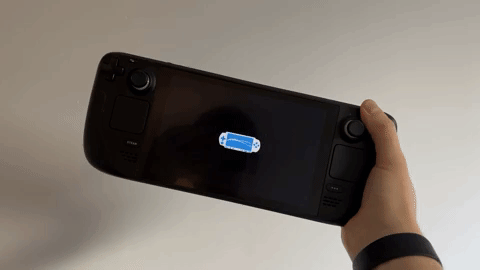
I’ve set custom boot-up screens, installed Decky Loader so I can tweak the Big Picture UI to match my vibe, and even customized the system sounds to echo classics — from the menu beeps of Resident Evil 2 to the interface of Metal Gear Solid V, or even Final Fantasy XIV. It's the little things like this that make the experience feel personal — like I’m holding a piece of tech that actually reflects me. The games? Oh, it plays games. Thousands of them natively, from indie hits to full-blown AAA monsters. And for the ones that are just too massive to fit or too demanding to run locally, I can stream them — straight from my desktop PC, from the cloud, or even from my PlayStation 5.

Seriously, how wild is that? The Steam Deck handles remote play from my PS4, PS5, and Xbox Series X without breaking a sweat. And yes, it can even run Xbox Game Pass titles. Downloadable. Playable. On the go. That kind of flexibility still surprises me sometimes — not because it can, but because it actually lets me. Want to install other game launchers? Go for it. Battle.net, GOG, Ubisoft Connect, Epic Games Store — they’re all welcome here. My library isn’t stuck behind one storefront, and my games aren't limited by some corporate garden wall.
And then we get to emulation.

The Steam Deck is, without exaggeration, an emulation powerhouse. It’s a portable retro dream machine. And while Nintendo’s decision to finally add GameCube titles to Nintendo Switch Online for Switch 2 is… fine, launching with just a handful of games feels more like a slow drip than a celebration. Meanwhile, my Steam Deck has been running virtually the entire GameCube library for a while now thanks to Dolphin — and it does it really well. And it doesn't just play these games, you can also improve your experience with a variety of options with things like widescreen hacks, HD texture packs, button remapping, custom controller layouts — it’s not just preservation, it’s enhancement. And it doesn’t stop there. From NES to PS2, Dreamcast to 3DS, Wii U to Vita — if it ever ran on silicon, there’s a decent chance the Steam Deck can emulate it. And not in a janky “sort of runs if you’re lucky” kind of way. In a “this feels shockingly official” kind of way.
When I say the Steam Deck is the ultimate handheld? I mean it. It’s not sleek or shiny like the Switch 2. It doesn’t have Nintendo’s trademark whimsy. But it has something I think is even more valuable: freedom. It lets me play how I want, where I want, and on my terms.
And for many, I know the Steam Deck might seem intimidating — all those options, all that flexibility. But here’s the truth: the experience can be as simple or as advanced as you want it to be. If you just want to pick up a device and play your Steam games? That out-of-the-box experience is as seamless and straightforward as it gets. It boots up, you pick a game, and you’re off. It runs games — and it runs them well.

But if you do want to go deeper, to tinker and customize and tailor the experience to your tastes? The Steam Deck is ready. And you want to know what I find amazing? I can switch between Elden Ring and Vampire Survivors in seconds. I can pause Hades, check Discord, install a mod for Fallout: New Vegas, and jump right back into the action like nothing happened. It’s chaos. It’s power. It’s possibility. And the biggest difference? I feel like I’m being invited to explore, not just consume. That’s the beauty of it. The Steam Deck doesn’t lean on nostalgia or deluxe editions to keep my attention. It earns it. It respects my time, my choices, and my curiosity. And for that? It’s hard not to love it.
So where does that leave us?
Well, I’ll be honest. I’m glad I bought a Switch 2. Really, I am. It feels great in the hands. Mario Kart World is fun — a little safe, sure, but fun all the same. And I’m still holding out hope that Metroid Prime 4: Beyond will be the system-seller Nintendo needs it to be — because I want to feel that spark again. I want to be swept up in the magic of a new Nintendo generation.

I’m even looking forward to Donkey Kong Bananza. Not only does it look like a ton of fun, but it’s also priced at $69.99 — a full ten dollars less than Mario Kart World. Honestly, based on everything shown in the dedicated Bananza Direct, THIS should’ve been the launch title. It may not be Breath of the Wild (seriously, how do you even top a game like that?), but it’s being developed by the team behind Super Mario Odyssey — one of the best Mario games in recent memory. A lot of people are already calling it “Donkey Kong Odyssey,” and honestly? That fits. You can feel the DNA of Odyssey all over it. But hey — what’s done is done. The Switch 2 is out. Mario Kart World is out. And more games are on the way.
Here’s the honest truth, though: when I look at how much I’ve spent on the Switch 2 — the console, the accessories, the online subscription, the games — and then I look at everything I get from my Steam Deck for roughly the same price? The difference is night and day.

One gives me a curated, limited, and increasingly expensive experience built on nostalgia and familiarity. The other gives me options. Freedom. Power. A library that spans generations and genres. A device that doesn’t just let me play — it lets me steer, explore, and shape the experience. And when you stack them side by side, it becomes clear: the Switch 2 isn’t a bad console — it’s just not a great value. Not yet. And that’s okay. You don’t have to choose just one.
But if you’re thinking about where to put your hard-earned money — especially in a world where everything is already costing more — my advice is simple: weigh your options. Ask yourself what matters more. Simplicity? Flexibility? Nostalgia? Performance? First-party exclusives? Modding freedom? Because if you want plug-and-play charm with iconic Nintendo polish, the Switch 2 will probably make you happy. But if you want control, versatility, and the kind of gaming experience that grows with you? The Steam Deck might just be everything you didn’t know you were missing.
Thanks for reading.
Sincerely,
BlueNile101


https://soicauxsmb.com/ bữa thấy bạn bè nói nhiều quá nên mình cũng ghé thử cho biết. Mình không đọc sâu đâu, chủ yếu lướt xem họ làm giao diện ra sao thôi. Ấn tượng đầu là trang nhìn khá sáng và dễ thở, kéo xuống không bị rối mắt. Mấy phần thông tin được chia thành từng khối rõ ràng nên mình bắt nhịp nhanh, nhìn qua là hiểu đang ở mục nào. Mình cũng thích chỗ họ trình bày số liệu kiểu gọn gàng theo bảng/cột, đỡ phải căng mắt tìm từng dòng. Với lại thanh menu để ngay chỗ dễ thấy nên chuyển qua lại vài mục cơ bản khá tiện, không phải bấm mò. Nói chung lướt vài…
https://keonhacai5.net/ dạo này thấy mọi người nhắc hoài nên mình cũng bấm vào nghía thử cho biết. Mình không đọc sâu đâu, chủ yếu xem giao diện với cách họ sắp xếp nội dung có dễ nhìn không. Vừa vào là thấy bố cục khá gọn, kiểu chia thành từng khối rõ ràng nên lướt xuống không bị rối mắt. Mấy phần thông tin họ để theo dạng bảng/cột nhìn cái là hiểu nhanh, đỡ phải kéo qua kéo lại tìm từng dòng. Menu đặt ngay chỗ dễ thấy nên mình chuyển qua vài mục thử cũng tiện, không bị cảm giác “lạc” trong trang. Nói chung trải nghiệm lướt ổn vì các khối nội dung và bảng cột trên…
sun win mình lướt thử đúng kiểu tò mò xem trang làm ăn ra sao, chứ chưa kịp chơi gì nhiều. Vừa vào thấy họ để tiêu đề “cổng game chính thức 2026” khá to nên mình đỡ phải đoán có vào nhầm chỗ không. Giao diện nhìn gọn, các khối nội dung chia rõ ràng nên kéo xuống không bị ngợp, nhất là trên điện thoại chữ vẫn dễ đọc. Mình cũng để ý họ nói hệ sinh thái trò chơi phong phú với trải nghiệm hiện đại, nhưng mình chỉ xem qua phần giới thiệu thôi. Điểm mình thích là menu đặt chỗ dễ bấm, chuyển trang mượt, không phải tìm vòng vòng. Nói chung cảm giác trang…
bot4x.io dạo này thấy nhiều người nhắc nên mình cũng ghé thử cho biết, kiểu vào xem bố cục với cách họ trình bày thông tin thôi. Vừa mở ra thấy giao diện khá dễ nhìn, các mục chia thành từng khối nên lướt nhanh vẫn hiểu đại khái. Mình để ý phần nói về giấy phép PAGCOR được đặt khá nổi, không phải kéo xuống sâu hay bấm vòng vòng mới thấy, nên cảm giác họ cố làm rõ ngay từ đầu. Chữ cũng vừa phải, không nhồi nhét, đọc vài đoạn là nắm ý. Mình không ngồi lâu, chỉ click qua lại vài mục mà không bị rối. Nói chung ấn tượng là trang sắp xếp gọn gàng,…
hitclub6.it.com bữa lướt thấy ai đó nhắc nên mình bấm vào coi thử cho biết thôi. Mình không chơi gì nhiều, chủ yếu xem trang làm có dễ nhìn không. Cảm giác đầu tiên là giao diện khá “hiền”, chữ nghĩa rõ ràng, không bị nhồi nhét nên kéo xuống đọc cũng thoải mái. Mấy mục nội dung được chia thành từng khối nhìn gọn, kiểu lướt qua là nắm được họ đang nói về cái gì, không phải đoán. Mình cũng để ý bấm qua lại mấy trang con thấy tải nhanh, không bị đứng hay giật. Nói chung nhìn có vẻ họ chăm chút phần trình bày và sắp xếp thông tin, nhất là menu và các tiêu…